The Board Chair of the National Film Authority,Ivan Quashigah has cautioned industry players against treating the Film Development Fund as “free money,” insisting that the initiative must be used to rebuild and sustain Ghana’s struggling film industry.
Speaking at the official launch of the fund at the Silverbird Cinemas inside the Accra Mall, the filmmaker stressed that the GH¢20 million government seed allocation should be viewed as an investment tool rather than a cash-out opportunity.
“The Film Development Fund must not be misunderstood. It is not a bonanza. It is not an opportunity for practitioners to dip into public resources and go on a spending spree,” he stated.
According to him, the Fund was established to drive long-term growth in Ghana’s film and audiovisual sector through quality productions, business development, and stronger industry structures.
Government has finally acted on its promise to the film industry — Kafui Danku
“Rather, it is a strategic investment vehicle that must be used judiciously to produce quality films, build sustainable enterprises, strengthen value chains, and revive the Ghanaian film industry,” he added.
The launch also featured the inauguration of the Film Development Fund Management Committee and the Film Classification Committee, both expected to play key roles in managing and regulating the industry.
Mr Quashigah described the initiative as a major turning point for Ghanaian cinema, noting that filmmakers have survived for years despite limited funding, inadequate infrastructure and distribution challenges.
He explained that the Fund is expected to support film production, training, exhibition, distribution and infrastructure development while also helping Ghanaian content reach wider local and international audiences.
“The GH¢20 million seed allocation must be seen not as an end in itself but as a seed that must be nurtured to bear the desired fruits,” he said.
He further called for funded projects to be commercially viable and structured in ways that allow profits and returns to flow back into the system to support other filmmakers.
“Projects should be structured in a way that allows funds to return into the system so that other filmmakers can also benefit. In this way, the fund can become revolving, regenerative and sustainable,” he stated.
Touching on the broader economic impact of film, Mr Quashigah said the creative industry has the potential to create jobs, boost tourism, preserve culture and contribute significantly to national development if properly supported.
“This clearly demonstrates that film is not merely entertainment. Film is an economic infrastructure,” he noted.
As part of efforts to improve access to films across the country, the NFA is also pushing the Ghana Cinema Train Initiative, an outreach project aimed at taking films beyond traditional cinema spaces in Accra to underserved communities nationwide.
PAT/EB
Entertainment of Thursday, 21 May 2026
Source: www.ghanaweb.com
'GH¢20 million creative arts fund not a bonanza' - Ivan Quashigah
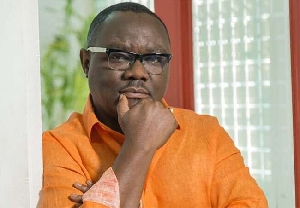 Ivan Quashigah is the Board Chair of the National Film Authority