The Institute of Economic Research and Public Policy (IERPP) has welcomed Ghana’s reported US$2.62 billion in Foreign Direct Investment (FDI) saying it is an encouraging sign that international investors still find opportunities and potential in the Ghanaian economy in 2025.
But the Institute says the joy must be tempered with a sober assessment of the huge financial losses involved in the Domestic Gold Purchase Program (DGPP).
“Certainly, we should acknowledge Ghana’s capacity to draw US$2.62 billion in foreign direct investment,” said Prof. Isaac Boadi, Executive Director of IERPP. It is a sign that in spite of the economic challenges we are experiencing, international investors still have confidence in the opportunities in Ghana. But we cannot be happy about the money flowing into the economy when we are not looking at the big losses happening in the economy.”
Based on the figures that have emerged from the recent discussions on the DGPP, the program lost an estimated GH¢22 billion, an equivalent of US$1.7 billion.
The comparison with the US$2.62 billion FDI figure is striking when set against the reported DGPP loss of a similar magnitude around 65% of the value of Ghana’s FDI inflows, the IERPP argues.
“Every US$1 that Ghana attracts in FDI, the reported loss under the Domestic Gold Purchase Program is equivalent to about 65 cents,” Prof. Boadi observed. “Not that the FDI was lost or that GoldBod was responsible for the entire loss of US$1.7 billion. The point is to show the magnitude of the loss relative to the capital we are celebrating.”
The IERPP emphasizes the importance of this distinction, stating the US$1.7 billion figure reported refers to losses under the DGPP as a program and cannot be directly attributed in its entirety to GoldBod.
But the costs and fees associated with GoldBod identified as part of the programme’s losses must also be properly subject to public scrutiny.
“The question is, are we paying enough attention to how well we manage and protect the resources that we already have in our economy?” Prof. Boadi asked.
The Institute also argued that foreign investment remains vital to Ghana’s economic transformation.
FDI can support job creation, technology transfer, productive capacity, infrastructure and foreign-exchange generation, the institute noted but stressed that attracting foreign capital, cannot substitute for prudent management of public resources.
“Imagine filling a bucket with water while leaving a large hole at the bottom,” Prof. Boadi explained.
He added: “It would be good news that more water is being poured into the bucket, but the greater responsibility is to ask why we are allowing such a significant amount to escape.”
IERPP is therefore calling for greater transparency regarding the reported DGPP losses including a clear breakdown of the sources of the losses, the costs incurred, the revenues generated, the role of GoldBod-related fees and charges, and the ultimate fiscal impact on the state.
The Institute also believes that Ghana’s accountability institutions, Parliament, civil society organisations, think tanks and the media all have a responsibility to interrogate the figures with the same intensity with which positive economic developments are celebrated.
“There should be no selective enthusiasm when it comes to Ghana’s economic numbers,” Prof. Boadi stated, asserting that “when the figures are positive, we must celebrate them; when the figures reveal significant losses, we must ask difficult questions. Both are necessary for a credible economic conversation”.
IERPP also maintained that genuine investor confidence is not built merely by attracting foreign capital but by demonstrating that Ghana has strong institutions, transparent public financial management and the capacity to safeguard economic resources.
“We must celebrate Ghana attracting US$2.62 billion in FDI.”
“But at the same time, we must have the courage to ask why a reported US$1.7 billion loss under the domestic gold programme is equivalent to almost two-thirds of that inflow. Ghana needs both investment and accountability. One without the other cannot deliver sustainable economic transformation,” Prof. Boadi concluded.
Business News of Sunday, 30 August 2026
Source: classfmonline.com
Why celebrate $2.62bn FDI while losing $1.7bn under DGPP? - IERPP quizzes
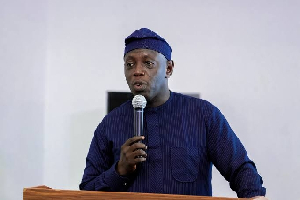 Prof. Isaac Boadi, Executive Director of Institute of Economic Research and Public Policy