Host communities of the Damang Gold Mine have welcomed what they describe as encouraging developments barely four months after Damang Gold Mine Limited (DGML) took over the operation.
The communities cited progress on infrastructure projects, local employment and engagement with traditional leaders as early signs of a positive relationship with the Ghanaian-owned mining company.
The Damang mining lease transitioned to DGML on April 18, 2026, following the change in ownership and management of the mine.
Speaking at a press conference on behalf of the host communities, the Chief of the Bosomtwi Divisional Council, Nana Kwabena Amponsah IV, said the communities were encouraged by the developments since the transition.
“We have gathered today to publicly acknowledge the positive relationship that has developed between Damang Gold Mine Ltd and its host communities since the company assumed responsibility for the Damang Mine,” he said.
Projects underway
Among the developments highlighted by the communities is the proposed airstrip at the Huni waste dump.
DGML has completed the design of the facility and commenced preliminary earthworks. The Ghana Civil Aviation Authority and the Prestea-Huni Valley Municipal Assembly have also been engaged to inspect the site and support the regulatory processes.
Work has also commenced on the Damang-Subri section of the Damang-Subri-Praso-Cape Coast road.
According to the communities, sections of the road have been cleared, cut and filled with suitable materials, while culverts have been constructed at waterlogged areas to improve drainage.
The communities believe the road will improve the movement of people and goods and provide better access to markets, schools and health facilities.
DGML is also preparing to construct three astroturf facilities at Subri, Damang and Huni Valley.
The company has requested land from traditional authorities, while a consultant visited the proposed sites in July. The contractor is expected to mobilise and begin work by mid-August.
Nearly 400 locals in recruitment process
Employment has emerged as another key area of interest for the host communities.
Under an agreement with the communities, 60 per cent of DGML's employees are expected to be recruited locally, with the remaining 40 per cent coming from outside the immediate catchment.
The company says nearly 400 people from the catchment communities have entered various stages of its recruitment process.
Of that number, 180 have already been engaged and are working, while 135 candidates are undergoing final recruitment processes, including medical examinations and induction. Another 85 candidates have completed interviews and are awaiting results.
The communities have welcomed the development but are calling for greater investment in training, apprenticeships and skills development to improve the long-term employability of young people.
They are also urging DGML to provide more opportunities for qualified local businesses and contractors to participate in the mine's procurement and supply chain.
The communities also highlighted improved engagement with DGML through the Social Responsibility Forum and other established platforms.
According to them, discussions on employment, economic opportunities and community development, including the proposed Development Foundation, have helped strengthen relations between the company and its host communities.
Nana Amponsah said the communities were prepared to support DGML as long as the relationship remained based on mutual respect, transparency, local participation, responsible mining and sustainable development.
“The message from Nananom and the people of the Damang Mine catchment communities today is simple: A new chapter has begun in the relationship between the Damang Mine and its host communities,” he said.
The communities, however, stressed that the early developments should be sustained and translated into completed projects, more employment opportunities and greater participation of local businesses in the mine's supply chain.
They also called for the commitments made during the transition to be implemented transparently and consistently throughout the life of the mine.
Business News of Tuesday, 11 August 2026
Source: Ebenezer Damptey, Contributor
Damang Mine: Chiefs welcome jobs and infrastructure projects under DGML
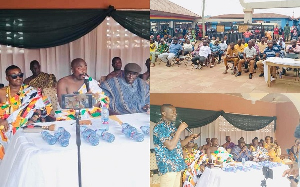 The communities cited progress on infrastructure projects, local employment and engagement




Entertainment