As military operations between the United States, Israel, and Iran intensify in the Persian Gulf, a narrow waterway thousands of kilometres from Ghana’s shores has suddenly become the most consequential geographic feature for the country’s economic stability.
The Strait of Hormuz — just 33 kilometres wide at its narrowest point — carries approximately 17 million barrels of oil per day, representing roughly 20 per cent of global oil consumption. Any disruption to this corridor, even a temporary one, sends immediate shockwaves through energy markets worldwide. Ghana, as a net importer of refined petroleum products, cannot afford to be caught unprepared.
The Strait of Hormuz: Why it matters to Ghana
The Strait of Hormuz lies between Iran, Oman, and the United Arab Emirates. Major Gulf oil exporters depend heavily on this route, and several economies channel most of their petroleum export revenues through it. Iran has previously signalled that the Strait could be targeted in the event of military escalation, and recent geopolitical developments have brought that threat closer to reality than at any point in modern history.
The transmission channels from a Hormuz disruption are well established: oil price volatility increases, global fuel and transport costs rise, inflationary pressures intensify across economies, and global economic growth slows.
For a country like Ghana, which imports the vast majority of its petrol, diesel, and LPG despite producing approximately 110,000 to 120,000 barrels per day of crude oil from fields including Jubilee, TEN, and Sankofa, the implications are direct and severe.
Ghana: Thousands of kilometres away, still in the firing line
Ghana’s vulnerability stems from a structural mismatch. The country produces crude oil but has severely limited refining capacity. The Tema Oil Refinery operates at roughly 28,000 barrels per stream day, well below its designed capacity of 45,000 barrels per day. This means Ghana exports crude at relatively lower value and imports costly refined petroleum products — a pattern that exposes the economy to every spike in global oil prices.
With deregulated fuel pricing, global price shocks pass directly to consumers. When oil prices surge, fuel prices spike at the pump. Since road transport carries the majority of goods across the country, everything becomes more expensive. Agriculture, which depends on fuel for irrigation, tractors, and transport, is hit hard. Food inflation, in turn, disproportionately affects lower-income households.
The cascade does not stop at fuel and food. Rising import costs mean more dollars are needed to pay for the same volume of goods, which puts pressure on the cedi. A depreciating currency erodes investor confidence, and a potential global recession triggered by the conflict could reduce demand for Ghana’s main export commodities — cocoa, gold, and oil — further weakening foreign exchange inflows.
Across the economy, sectors feel the squeeze differently but uniformly. Mining is energy-intensive and sees margins compressed. Construction, heavily dependent on fuel, sees projects slow or stall. Small and medium enterprises that rely on generators face threats to their viability. Thermal power plants confront higher fuel costs, raising the spectre of increased electricity tariffs or load-shedding.
Ghana’s External Sector: Not as fragile as it looks
There is, however, a side to Ghana’s external position that is frequently overlooked. According to Bank of Ghana data as at December 2025, the country runs a monthly trade surplus of approximately US$1.14 billion and a current account surplus of around US$756 million per month. Gold alone accounts for 67.4 per cent of goods exports, with monthly gold exports valued at US$1.748 billion. Oil imports represent 29.4 per cent of total goods imports, and Ghana’s net oil deficit stands at roughly US$208 million per month.
These figures suggest that under normal conditions, Ghana’s reserves accumulate rather than deplete. The challenge, however, lies in the magnitude and duration of shocks. Ghana’s oil revenue position is a double-edged sword: while higher global oil prices mean the country’s own crude fetches more on international markets, oil production has been declining from its peak, and any revenue windfall takes time to flow through to government coffers. Moreover, a potential global recession could pull commodity prices back down, negating any short-term gains.
Two Ghanas: With and Without GANRAP
Without GANRAP, Ghana enters the crisis with approximately 5.7 months of import cover. The oil import bill rises by 39 per cent, and while gold co-movement largely offsets the shock under current conditions, the risk remains significant if compound shocks materialise or if the historical gold–oil correlation falters. Inflation could rise to 7 to 8 per cent, the cedi would face moderate depreciation pressure of 5 to 8 per cent, and pressure for yet another IMF programme would mount. Recovery would take two to three years.
With GANRAP, the picture is fundamentally different. Reserves stand at 15 or more months of import cover, held in an asset that appreciates during crises. GANRAP’s foreign exchange generation rises to US$30.9 billion per year at crisis prices, more than offsetting the US$1.99 billion oil shock. Import cover actually improves to approximately 16 to 17 months by year two, reflecting both gold price appreciation and incremental ASM formalisation. The cedi stabilises, inflation remains within the baseline range of 5 to 7 per cent, no IMF bailout is required, and the debt burden remains unchanged because gold, unlike bonds, creates no liability.
Breaking the Inflation Chain
The transmission mechanism from oil shocks to domestic inflation is well understood: oil prices rise, foreign exchange drains increase, the cedi depreciates, and inflation accelerates. Without GANRAP, the net monthly oil drain of US$81 million, while modest against a current account surplus of US$756 million per month, still contributes to cedi depreciation of 2 to 3 per cent and an inflation pass-through of approximately 1 percentage point, pushing projected inflation to between 6 and 8 per cent.
GANRAP breaks this chain. With monthly foreign exchange generation of US$2.57 billion, the residual foreign exchange position remains in surplus. Cedi depreciation drops to approximately zero, the inflation pass-through is eliminated, and projected inflation stays within the 5 to 7 per cent baseline. The core mechanism is straightforward: as gold prices rise, gross international reserves increase, the cedi remains stable, and inflation stays contained.
Beyond GANRAP: An Integrated Policy Response
While GANRAP serves as the primary shield, a comprehensive response to the Hormuz threat requires complementary measures. Energy diversification is essential: Ghana has significant untapped solar potential, and accelerating investment in renewables would reduce dependence on imported thermal fuel. Expanding domestic gas utilisation would further insulate the power sector from external shocks.
Building strategic fuel reserves of 60 to 90 days would provide critical time to adjust during supply disruptions. Rehabilitating the Tema Oil Refinery to process the country’s own crude into refined products would address the fundamental structural weakness of exporting crude cheaply and re-importing expensive fuel, reducing the foreign exchange outflow for petroleum imports.
Fiscal buffers must also be strengthened. Rebuilding the Stabilisation Fund under the Petroleum Revenue Management Act and saving oil revenue windfalls for deployment during shocks would complement GANRAP’s gold reserves with fiscal savings. Social protection mechanisms, including targeted transfers for vulnerable households, fuel subsidies for public transport during emergencies, and food price stabilisation, would cushion the impact on those least able to absorb it.
Conclusion: The War Makes GANRAP Urgent
The Strait of Hormuz is just 33 kilometres wide, but as of 28 February 2026, it is at the centre of a live military conflict. Its closure or even partial disruption would reach Accra, Kumasi, Takoradi, and Tamale in the form of higher fuel prices, rising food costs, a weakening currency, and accelerating inflation.
Ghana has faced this pattern before — in 2000, 2014, and 2022 — each time with reserves too low to absorb the shock and each time requiring external assistance to stabilise. GANRAP offers a different path: 15 months of gold-backed reserves that appreciate in value during the very crises they are designed to insure against, at a fraction of the cost of Eurobond-financed alternatives, and without adding a single dollar to the national debt.
The empirical evidence is clear. The historical pattern is consistent. The production requirements are achievable. And the cost savings are enormous. Ghana cannot control what happens in the Persian Gulf, but it can control how prepared it is. GANRAP is that preparation. The country should be turning its gold into reserves, not into debt.
Business News of Monday, 23 March 2026
Source: thebftonline.com
The US-Israel-Iran War: How gold-backed reserves can shield Ghana from crisis
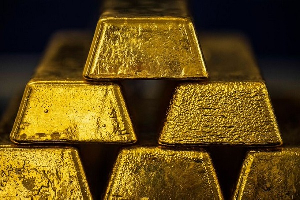 File photo of gold bars