President John Dramani Mahama has stated that the real value of the cedi lies between GH¢10 and GH¢12.
He emphasised that despite the cedi’s current performance, there needs to be a fair balance to sustain the economy.
According to him, the Minister for Finance and the Governor of the Bank of Ghana are working to ensure that the cedi's appreciation is balanced in terms of both demand and supply.
Speaking on June 3, 2025, President Mahama said, "The recent appreciation in the value of the cedi is something we’ve been monitoring closely. As the cedi began to strengthen and the dollar depreciated, we knew from basic A-level economics that this is a balance between imports and exports. What this means is that imports become cheaper, while exports become more expensive."
He noted that the Economic Management Team has determined a realistic valuation for the cedi, cautioning that the currency cannot appreciate to GH¢4 or even GH¢1, as some have speculated.
"There must be a fair balance to reflect the true value of the cedi. Some people say, ‘Oh, it will come down to four,’ but of course, we know the true value is not GH¢4. If it went that low, it would destroy our export businesses. That’s why I met with the Governor of the Bank of Ghana and the Finance Minister, and we all agreed that the cedi’s real value lies somewhere between GH¢10 and GH¢12."
The President further stated that this range ensures a sustainable economic environment and prevents the cedi from falling below GH¢12.
"Fortunately, the recent forex auction has pushed the rate slightly above GH¢10, and it appears to have stabilized there. Going forward, I believe anything between GH¢10, GH¢11, and GH¢12 provides a fair value. It encourages our exports while ensuring that imports don't become so cheap that they flood our markets with toothpicks, biscuits, coconuts, and other non-essential items."
While the appreciation of the cedi has made imports cheaper, President Mahama cautioned importers to be responsible and not oversaturate the market with foreign goods at the expense of local products.
"This is a call to our exporters to take advantage of the cedi’s appreciation. Raw materials are now cheaper, fuel prices have dropped, transportation costs are lower, and port charges have reduced. These are clear incentives for export growth.
"But I’m also urging importers not to exploit the situation by flooding our markets with things like Nkatie burger and similar imports. Let’s focus more on import substitution. Let’s produce as many of the goods we import right here in Ghana," he said.
SSD/MA
Business News of Tuesday, 3 June 2025
Source: www.ghanaweb.com
Cedi's true value is between GH¢10 and GH¢12 - President Mahama
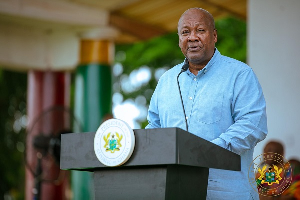 President John Dramani Mahama