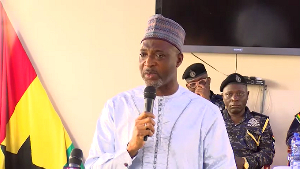
Policy analyst and Vice President of IMANI Africa, Bright Simons, has challenged the State Interests and Governance Authority’s (SIGA) latest State Ownership Report, arguing that several errors and inconsistencies make its reported improvement in the performance of state-owned enterprises unreliable.
In a post on X on Sunday, September 6, 2026, Mr Simons said SIGA had presented the reported GH¢19.80 billion profit in 2025 as a major turnaround after years of losses.
He, however, said his analysis of the report painted a different picture.
“Unfortunately, it simply doesn’t hold up,” he stated.
Bright Simons said he and his team used Tabula and Excel Power Query to extract and examine financial figures from the report.
SIGA reports compiled manually, not with AI — Professor Kpessa-Whyte clarifies
He stressed that the tools were used only to process large amounts of data.
“We have taken the SIGA report to task,” he said, adding that the report contained “bizarre errors, misstatements, confusions, and flawed inferences.”
He cited discrepancies in figures published in SIGA’s various reports as one of the major concerns.
According to him, the net loss for 2023 was reported as GH¢2,573.2 million in the 2023 report, GH¢7,143.5 million in the 2024 report and GH¢6,823.55 million in the 2025 report.
He said the net loss for 2022 was also published in four different ways, while revenue for 2021 appeared in five different forms.
Another example he cited was total liabilities for 2021, which appeared as GH¢135,883 million in the 2021 report, GH¢172,043 million in the 2023 report and GH¢135,914 million in the 2025 report.
“These confusions make it really hard to make comparisons across years,” he said.
Bright Simons further disputed SIGA’s claim that the underlying profitability of state-owned enterprises improved in 2025.
He said that after removing currency effects, net profit actually fell by 17.1 per cent, operating profit declined by 22.7 per cent, and the operating margin narrowed by 3.5 percentage points between 2024 and 2025.
According to him, the reported increase in profit was largely influenced by foreign exchange revaluations at the Electricity Company of Ghana (ECG).
He said ECG moved from an exchange rate loss of GH¢8,837.71 million in 2024 to a gain of GH¢12,157.79 million in 2025.
He said the GH¢20,995.50 million swing represented 95.2 per cent of the total GH¢22,058.91 million profit swing highlighted by SIGA.
“Take exchange rate revaluations out, and ECG’s operating result changes from a GH¢1.84 billion profit to a GH¢14.25 billion loss,” he stated.
He also questioned the dividend figures, saying only $1.4 million in dividends were realised from the 53 fully state-owned enterprises in 2025.
According to him, the dividend amount fell by 45.5 per cent compared with 2024.
He further pointed to what he described as a GH¢50.9 billion error in SIGA’s 2021 cost figure, saying GH¢104.97 billion was used instead of GH¢54.04 billion.
He alleged that the incorrect figure was copied from the 2023 figure.
“Most of the improvement is from a pure mistake,” he stated.
Bright Simons has therefore called on SIGA to withdraw its reports dating back to 2020 and correct the errors before producing a reliable series of figures.
He said the inconsistencies also included a GH¢7.42 billion difference in the reported 2024 losses and questions surrounding a GH¢12.69 billion fall in equity in 2025.
“SIGA should withdraw all its reports from 2020,” he said, insisting that the figures must be corrected before the performance of state-owned enterprises can be properly assessed.
ANAS/EB
Technology will be key to improving air traffic management – President Mahama
Business News of Sunday, 6 September 2026
Source: www.ghanaweb.com
Bright Simons calls out material errors and flawed numbers in SIGA report
 Bright Simons is the Vice President of IMANI Africa