Almost 20 years after peace returned to northern Uganda, many people are still struggling with trauma from the Lord’s Resistance Army (LRA) war. Communities that lived through killings, displacement, and destruction continue to suffer from post-traumatic stress disorder (PTSD).
A 2021 study by the Justice and Reconciliation Project found that in northern Uganda, 55 percent of former child soldiers suffered from PTSD, while 88.2 percent showed signs of depression. The research involved 102 former child soldiers.
Mental health experts say the region is facing high levels of suicide, murder, and depression, and yet there are very few psychologists and psychiatrists available to support survivors of war trauma. As a result, some of the victims have turned to therapy dogs to cope. Mr Robert Onen, 37, an ex-LRA combatant, says he has been struggling with PTSD for 15 years.
“I went through a very bad experience. I was abducted by the LRA rebels in 2000. I spent about five years in the bush with the rebel group,” he says. Mr Onen says when he returned from the bush in 2005, he struggled with sleepless nights because he feared the rebels would attack his village again. He adds that he became short-tempered and violent, often getting so angry at insults that he sometimes felt like killing whoever mocked him.
“I used to have nightmares. Sometimes, I wake up and think I am still in captivity. I was also facing a lot of discrimination after I returned home from the bush. I had no friends. No one was comfortable sitting near me,” he adds.
Following the advice of a friend, Mr Onen decided to get a therapy dog through the Comfort Dog Project, which is being implemented by The Big Fix Uganda, a non-governmental organisation.
He says the therapy dog helped him cope with life after the LRA.
“I got my first therapy dog in 2020. Unfortunately, it died after four years. The death of the dog left me an empty person. He was a dear friend to me because it did not stigmatise me. It used to welcome me before my wife and children. I came back and got another therapy dog. This time, I got a female dog. I have a happy dog. And that makes me happy,” he says.
Mr Onen was still a student when rebels raided his village and abducted him. Today, he works with The Big Fix Uganda as an animal welfare officer and also practices small-scale farming. Last week on Wednesday afternoon, he was one of 18 people who graduated at the 11th graduation ceremony of the Comfort Dog Project. Since it started in 2014, the Comfort Dog Project has supported at least 134 people battling grief, depression, and post-traumatic stress disorder (PTSD).
It is the first programme of its kind in Africa. The project has also helped survivors of domestic violence and families mourning the loss of loved ones. Ms Alice Angee, a resident of Bar Cell in Laroo-Pece Division, Gulu City, says the project helped her heal from the grief of losing her mother two years ago.
“The reason why I chose animal therapy is that I went through a lot of tough times after I lost my mother in April 2023. After she died, I became depressed and sick. I was very forgetful,” she says. “The death of my mother changed my life completely. Worse of all, being the eldest child to my parents, I had to handle almost every single problem the family was facing. That was overwhelming for me,” she adds. She says the therapy dog has given her hope and a second chance in life.
“I used to have pain in my head every single day. I was later advised to enrol on the dog therapy programme. I later got a therapy dog. She is like my seventh child. My children love her too,” she says.
Ms Alice Layet, a resident of Ariya Cell, Laroo-Pece City Division in Gulu City, says without her therapy dog, she would be dead by now. “I was depressed. I was hopeless. But my dog, Watwero, gave me a second chance in life. The dog taught me patience and love. I am now sharing my experience with my village mates. I want them to heal too,” she adds. Ms Aber, a resident of Lapinyoloyo Village, Labora Sub-county in Omoro District, says the dog gave her a new lease on life after years of domestic violence.
“My husband was very violent toward me. Whenever he is drunk, he threatens to kill me. I could not sleep at night for fear that he was going to kill me. There was no happiness in our home. He used to drink a lot until lately, when he became sickly,” she says.
Mr Francis Okello Oloya, who manages the Comfort Dog Project at The Big Fix Uganda, says using dogs for therapy really works. He says dogs helped him deal with depression after he lost his sight at the age of 12 when an unexploded bomb injured him. “For the last 11 years that we have been running this programme, so many clients who have been assessed with severe symptoms of post-traumatic stress disorder and depression have been getting support through the companionship of dogs,” he notes.
“A dog does not stigmatise you after being abducted. It does not remind you of being in the military. Or you have done bad things. The dog will accept you the way you are, unlike human beings,” he says.
Mr Oloya says people dealing with trauma can freely share their experiences with a dog without worrying that their secrets will be exposed to anyone else. “In a way, you are venting out your anger. You are releasing the heaviness of those symptoms. You are telling the story to the dog, and the dog is listening. So, you are letting it out,” he says.
“The dogs have always demonstrated a very strong attachment to humans. Even when it walks away, it will still come back home and will want to look for you and stay with you for the rest of its life. But when you look at cattle and goats, they will walk away and forget about you,” he added.
Africa News of Monday, 29 September 2025
Source: monitor.co.ug
How dogs are helping trauma survivors heal
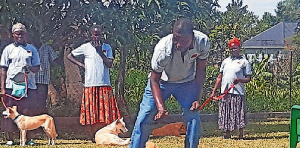 Robert Onen, an ex-Lord’s Resistance Army (LRA) combatant, plays with his therapy dog



Entertainment