Geopolitics and football have collided once again following the escalation of tensions between the United States and Iran, raising questions about whether the upcoming 2026 FIFA World Cup could be affected.
With the tournament set to take place across North America, some observers have begun drawing comparisons with the fate of Russia after the Russian invasion of Ukraine in 2022, when Russian teams were banned from international football.
The debate intensified this week after US President Donald Trump issued a warning about Iran’s possible participation in the tournament on Thursday, March 12, 2026.
“The Iran national soccer team is welcome to the World Cup, but I really don't believe it is appropriate that they be there, for their own life and safety,” Trump wrote on his Truth Social platform.
Iranian national team fires back at Donald Trump over World Cup comment
His remarks came only two days after Gianni Infantino revealed he had met Trump at the White House to discuss preparations for the tournament and the broader geopolitical situation.
“President Trump reiterated that the Iranian team is, of course, welcome to compete in the tournament in the United States,” the FIFA president said after the meeting.
Despite the tensions, there has been no indication that the United States could lose its hosting rights, and the reasons lie in how the Russia situation unfolded.
When Russia invaded Ukraine in 2022, the sanctions imposed by FIFA and UEFA did not target a host nation.
Instead, they directly suspended the Russian national football team and Russian clubs from international competitions.
The decision came after several European teams publicly refused to play Russia, effectively forcing football authorities to act in order to keep competitions running.
The current situation is very different. The United States is not a team facing suspension but a host nation responsible for organizing the tournament.
In addition, the 2026 World Cup is uniquely structured. The tournament will be jointly staged by the United States, Canada and Mexico, with matches spread across multiple cities in the three countries.
Removing the United States from that arrangement would require FIFA to completely redesign the tournament’s venues, logistics, broadcast plans and commercial agreements.
While FIFA has the authority to revoke hosting rights in extreme circumstances, history shows the organization is extremely reluctant to remove a host country purely for political reasons.
For example, the 2022 World Cup in Qatar faced widespread criticism over labor conditions, human rights concerns, and extreme weather, leading to public calls to relocate the tournament.
FIFA, however, refused to move the tournament, citing the enormous logistical, contractual, and infrastructural investments already in place.
Another key difference is the absence of a unified football boycott. In Russia’s case, multiple federations refused to face Russian teams following the Ukraine invasion.
At the moment, there has been no similar movement among football nations calling for matches to be moved away from the United States.
For FIFA, the priority remains ensuring that the tournament proceeds as planned while managing the political tensions surrounding Iran’s participation.
FKA/JE
ADHD Explained: What it really looks like in everyday life
Sports News of Friday, 13 March 2026
Source: www.ghanaweb.com
EXPLAINER: Why the US won't be sanctioned like Russia ahead of 2026 World Cup
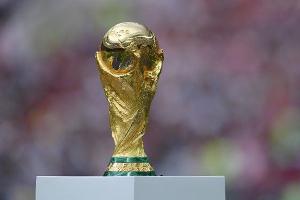 The World Cup trophy






Opinions