Ashaiman, one of the most densely populated communities in the Greater Accra Region, has a history rooted in migration, farming, fishing and trade, long before it became the bustling urban centre it is today.
Located near Tema, the town is believed to have emerged from settlements established by Ga migrants from the coastal communities, particularly Tema.
Its growth over the centuries was shaped by the arrival of people from different parts of Ghana, with the construction of Tema Harbour in the 1950s marking a major turning point.
Ashaiman is not a notorious town - Ashaiman MCE Freeman Tsekpo
Oral accounts trace Ashaiman's origins to early settlers, including Nii Atanya and Nii Ashai, who are associated with the establishment of farming and trading settlements in the area.
One account identifies Nii Atanya, a fisherman from Tema, as having established a settlement known as Nmpo-Asei Village, now associated with Official Town. Nii Ashai subsequently settled in the area and established another community along a route used by traders and travellers.
The name Ashaiman is commonly understood to have originated from the Ga words 'Ashai' and 'Mang', with the latter meaning town or community. It is therefore interpreted as 'Ashai's town'.
However, there are differing oral accounts about the town's original founder.
While the Ashaiman Municipal Assembly's historical account recognises Nii Ashai's role in its establishment, another account attributed to the town's traditional leadership identifies Nii Tetteh Amui I as the original founder.
These different accounts reflect the complexity of Ashaiman's traditional history.
From a small settlement to a commercial hub
In its early years, Ashaiman was largely a farming and trading community.
Its location along routes connecting Tema to inland settlements made it a convenient stopping point for traders and travellers.
The construction of Tema Harbour in the 1950s, however, changed the community's fortunes.
As Ghana pursued industrialisation under its first president, Dr Kwame Nkrumah, the development of Tema Harbour and its adjoining industrial area attracted workers from across the country.
The demand for accommodation in Tema exceeded the available housing, prompting many workers and their families to settle in neighbouring Ashaiman, where housing and land were relatively more accessible.
This influx of people accelerated the town's expansion, transforming it from a small settlement into a densely populated residential and commercial area.
Over time, more communities emerged, including Official Town, New Town, Lebanon, Jericho, Bethlehem, New York, Middle East, Tulaku and Roman Down.
The arrival of people from different ethnic backgrounds also gave Ashaiman its distinctive cosmopolitan character.
Residents from the Volta, Northern, Ashanti, Central and other regions established homes and businesses in the growing town.
Agriculture and the growth of commerce
Although urbanisation gradually changed Ashaiman's landscape, agriculture remained an important part of its economic history.
The Ashaiman Irrigation Project supported farming activities and contributed to food production in the area.
Trade also became central to the town's development. Ashaiman Market grew into an important commercial centre, attracting traders, shoppers and business operators from surrounding communities and beyond.
Its transport connections, informal businesses and busy trading activities further strengthened its position as one of the major commercial communities in the Greater Accra Region.
Ashaiman becomes a municipality
For many years, Ashaiman was administered under the Tema Metropolitan Assembly.
That changed in 2007 when the government established the Ashaiman Municipal District through Legislative Instrument 1889, separating it from the Tema Metropolitan District.
The Ashaiman Municipal Assembly was officially inaugurated on February 29, 2008, giving the area a separate administrative structure to oversee local governance and development.
Ashaiman today
Ashaiman has evolved into a major urban settlement characterised by a diverse population, vibrant commercial activities and a strong community identity.
The 2021 Population and Housing Census recorded 208,060 residents in the municipality, comprising 103,410 males and 104,650 females.
Its population includes people from several ethnic groups, including Ewes, Akans, Ga-Dangmes and Mole-Dagbani, reflecting decades of migration and settlement.
Beyond its commercial activities, Ashaiman has developed a reputation for its music, entertainment and street culture, contributing to its distinct identity within the Greater Accra Region.
From its beginnings as a settlement associated with Tema's early farming and fishing communities, Ashaiman has emerged as a densely populated municipality, with its history mirroring migration and urbanisation.
JKB/EB
GRA Intensifies Nationwide Tax Enforcement to Boost Revenue
General News of Sunday, 29 November 2026
Source: www.ghanaweb.com
Ashaiman: The story behind the rise of one of Ghana's busiest towns
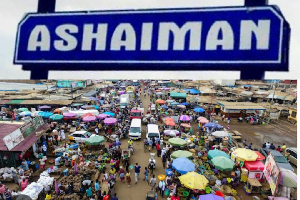 Ashaiman evolved from a small farming and trading settlement into a major urban centre