The Minister of Transport, Mr Joseph Bukari Nikpe, has outlined five strategic priorities aimed at transforming Ghana into a modern, technology-driven logistics hub capable of competing effectively within the West African sub-region.
The five priorities were contained in a speech delivered on his behalf by the Deputy Minister of Transport, Ms Dorcas Affo-Toffey, at the 29th Annual General Meeting (AGM) of the Ghana Institute of Freight Forwarders (GIFF) in Takoradi.
Speaking on the theme, “The Role of Artificial Intelligence (AI) in the Logistics Industry in Ghana”, the Minister said the future competitiveness of the country’s ports and logistics sector would depend not only on physical infrastructure but increasingly on intelligent, integrated, and efficient systems.
He said the first priority was to eliminate port congestion, delays in cargo clearance and unnecessary administrative bottlenecks that continued to affect traders and logistics operators.
He acknowledged the challenges at the Tema Port enclave and assured industry players that efforts were underway to improve cargo evacuation, harmonise terminal operations and deploy intelligent traffic management systems.
The second priority, he said, was to promote transparent, fair and competitive shipping and port-related charges to reduce the cost of doing business.
He reiterated the government’s commitment to addressing concerns over shipping line charges while ensuring that the country’s ports remained attractive and competitive.
The third priority focused on accelerating the responsible deployment of AI and integrated digital solutions throughout the logistics value chain.
“AI can improve predictive cargo management, intelligent port operations, customs processes, transport management, supply chain visibility and data-driven decision-making,” he said.
The fourth priority, he said, centred on investment in human capital, continuous professional training and institutional capacity-building.
He urged GIFF and other stakeholders to incorporate AI, digital logistics and data analytics into industry training programmes to ensure that Ghana’s workforce remained competitive in the evolving logistics landscape.
The fifth priority called for stronger partnerships among government, regulatory agencies and industry associations, stressing that meaningful transformation of the logistics sector required sustained collaboration between public and private sector stakeholders.
The Minister expressed confidence that the five priorities would position Ghana as a smart, efficient and dependable logistics hub, capable of leveraging AI to unlock greater trade opportunities and economic growth.
The President of GIFF, Mr Stephen Adjokatcher, said the institute had actively engaged the government and other stakeholders on port congestion and submitted proposals aimed at improving cargo evacuation and operational efficiency.
“These include streamlining shipping line release processes, promoting 24-hour operations, reducing excessive physical examinations and rationalising the presence of regulatory agencies within the ports,” he said.
He also announced plans to accelerate the institute’s digital transformation agenda through the introduction of a Management Information System (MIS) in partnership with CAS Broker.
The initiative, he said, was expected to enhance membership management, professional certification and communication, as well as facilitate the future integration of AI-driven services.
The Commissioner of the Customs Division of the Ghana Revenue Authority (GRA), Mr Aaron Kanor, who chaired the event, urged freight forwarders to uphold transparency in their operations and desist from under-declaring goods.
He called on them to support the division in achieving its revenue target for the year, while assuring them of the division’s commitment to facilitating their work.
The Omanhene of the Essikado Traditional Area, Nana Kobina Nketsia V, welcomed participants to the region and commended freight forwarders for their critical role in facilitating trade and supporting economic growth.
Solidarity messages were delivered by representatives of the Ghana Ports and Harbours Authority (GPHA), Ghana Shippers’ Authority, Customs Brokers Association of Ghana (CUBAG), Association of Customs House Agents Ghana (ACHAG), Ghana Link Network Services and the Ghana Maritime Authority.
Business News of Saturday, 28 November 2026
Source: www.ghanaweb.com
Transport minister unveils five-point agenda to modernise Ghana’s logistics sector
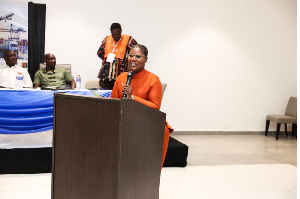 Transport minister, Dorcas Afo-Toffey




Entertainment