The late Agogomanhene, Nana Kwame Akuoko Sarpong, had his sights set on national politics when traditional authorities in Agogo approached him to occupy the paramount stool in 1975. He initially resisted, asking the elders not to stand in his way if he later decided to pursue a political career. They agreed, and what followed was a remarkable 51-year reign during which he also served as a Member of Parliament, government minister, lawyer, diplomat and statesman.
Nana Akuoko Sarpong, who died on March 26, 2026, aged 87, built an extraordinary public career that placed him at the centre of traditional authority and Ghana's political and institutional development.
His life brought together roles that rarely sit within one person's career. He was a practising lawyer who became a paramount chief, a traditional ruler who entered Parliament, a politician who served under the Provisional National Defence Council (PNDC), and a public figure whose influence extended into education, agriculture, sports and environmental conservation.
From Agogo to the University of Ghana
Born on August 11, 1938, in Agogo in the Ashanti Region, Nana Akuoko Sarpong began his education at Methodist and Presbyterian primary schools in his hometown, attending both institutions between 1945 and 1953.
He gained admission to Accra Academy in 1954, where he studied until 1957 and obtained the Cambridge School Certificate. In 1958, he proceeded to Opoku Ware School, joining the institution's first group of Sixth Form students. He completed his studies in 1959 with the Cambridge Higher School Certificate.
His academic journey continued at the University of Ghana, where he studied Economics, Sociology, Law and Political Science. He graduated with a Bachelor of Arts degree with honours in 1963 before returning to obtain an LLB degree with honours in 1965.
He was particularly active in student politics and leadership. At Commonwealth Hall, he served as secretary of both the Junior Common Room (JCR) and the Hall Union. He also belonged to the Hall's Debating Society and served on the editorial board of its weekly magazine, Echo.
In 1964, he contested and defeated Tawia Modibo Ocran to become President of the Commonwealth Hall JCR. He later became editor of Echo and again served as JCR President during his postgraduate studies.
One of his most enduring distinctions was becoming the first Chief Vandal of Commonwealth Hall, a position that became part of the hall's longstanding identity and traditions.
His leadership experience also extended to the Ghana Institute of Management and Public Administration (GIMPA), where he enrolled in 1964 to study Public Administration. He served as President of the Students' Representative Council and Acting President of the National Union of Ghana Students (NUGS).
He completed his GIMPA studies in 1965 and was called to the Ghana Bar in October of the same year.
A legal career before the Agogo stool
Nana Akuoko Sarpong began his professional legal career in 1966 as an Assistant State Attorney in Cape Coast. He later left the public service to join E.M.A. Ablor & Co. and subsequently became a founding member and Senior Partner of Forson, Sarpong & Co., which operated offices in Cape Coast and Takoradi.
His influence within the legal profession grew steadily. He served first as Secretary and later as President of the Central Region Bar Association before joining the Executive Board of the Ghana Bar Association. In 1972, he became Deputy Secretary of the national association.
He also served as Legal Adviser to the Oguaa Traditional Council and was a member of the Ghana Law Reform Commission. He later became a senior member of Nana Sarpong, Ahenkora & Co.
His legal and professional responsibilities were already well established when his life took a different turn in 1975.
How he became Agogomanhene
Before ascending the Agogo paramount stool, Nana Akuoko Sarpong had been enstooled as Safohene by the Oguaa Traditional Council in 1970.
His uncle, Nana Kwaku Duah, who was then Paramount Chief of Agogo, died in the early hours of December 16, 1975. Following his burial on December 22, the customary succession process began.
Agogo elders subsequently approached Lawyer Akuoko Sarpong and insisted that he accept the responsibility of leading the traditional area.
He was, however, reluctant to abandon his political ambitions. Having already developed an interest in national politics, he wanted the freedom to pursue a career in government and Parliament.
He therefore asked the elders to assure him that his acceptance of the stool would not prevent him from entering national politics in the future. They agreed, clearing the way for him to accept the traditional responsibility.
On December 23, 1975, at the age of 37, he was enstooled as Nana Akuoko Sarpong, Omanhene of the Agogo Traditional Area.
On January 16, 1976, he swore the Oath of Allegiance before the Asantehene, Otumfuo Opoku Ware II, at Manhyia Palace in Kumasi.
The Asantehene's message to the people of Agogo was particularly memorable.
“Now you have got a chief you deserve, a well-educated and brilliant lawyer. Hold him tight,” Otumfuo Opoku Ware II told the people.
It was the beginning of a reign that would last more than five decades.
From the palace to Parliament
Despite becoming a traditional ruler, Nana Akuoko Sarpong did not abandon his interest in politics.
His political involvement dated back to the formation of the Third Force Movement, which he joined alongside figures including John Bilson and Obed Asamoah.
He later served as General Secretary of the Republican Party before joining the Progress Party, where he became an executive member ahead of the 1969 general elections.
His biggest electoral breakthrough came in 1979 when he contested the parliamentary elections on the ticket of the Popular Front Party (PFP), led by Victor Owusu.
He won the Asante-Akim North parliamentary seat and entered Parliament during Ghana's Third Republic.
In Parliament, he served on the Select Committee on Defence and Interior and became the Minority Front Bench Spokesman on the same portfolios.
His parliamentary career was cut short following the overthrow of the Third Republic in December 1981. He was subsequently detained at Nsawam Prison as a political prisoner between 1981 and 1982.
His role in the Rawlings government
Nana Akuoko Sarpong's public service career took another significant turn during the PNDC era under Jerry John Rawlings.
In 1988, he was appointed Secretary for Health, a position he held before moving to the Internal Affairs portfolio.
He also served on two occasions as Acting Secretary for Foreign Affairs, participating in Ghana's diplomatic engagements at a particularly sensitive period in the country's international relations.
One of the notable diplomatic issues during that period was the effort to restore relations between Ghana and the United States following tensions linked to the Soussoudis affair in the late 1980s.
He subsequently served as PNDC Secretary for Chieftaincy and Culture and was involved in the country's transition from military rule to constitutional democratic governance in 1992.
His political career continued into the Fourth Republic, where he served as Presidential Adviser on Chieftaincy. In 2009, former President John Evans Atta Mills appointed him to the Council of State, where he served as an adviser on national affairs.
He also became Executive Chairman of the Ghana National Commission on Culture and a longstanding member of the National Democratic Congress (NDC) Council of Elders.
A traditional ruler with national and international influence
His influence was not limited to the Agogo Traditional Area.
As Omanhene, he became a member of the Ashanti Regional House of Chiefs, where he served as an adviser on environmental and health-related matters.
He was subsequently elected several times to the National House of Chiefs and became a founding member of the Association of West African Traditional Rulers, based in Niger.
His public engagements also took him beyond Ghana.
A respected speaker and commentator on political and social issues, he was given the opportunity to address the Congress of the State of Pennsylvania in the United States.
He also travelled extensively across Europe and America, delivering lectures and speaking at universities including Indiana University, Howard University, the University of California, the University of New Mexico, the University of Wisconsin and Lincoln University.
His engagements extended to social and professional organisations in New York, Washington, D.C., Texas and Florida.
His discussions covered Ghana's history, political development, African affairs and the country's place in international politics.
He also contributed to public debate through journalism, writing articles as a freelance journalist and regularly appearing on radio and television. At home, he maintained close links with university campuses, where he engaged students on Ghana's political development and international affairs.
He served as a part-time lecturer and honorary professor at the University College of Education, Winneba.
His other interests: Football, education and public service
Away from traditional leadership and politics, Nana Akuoko Sarpong maintained an active presence in several professional, sporting and educational institutions.
He served as a board member of Graphic Corporation and chaired several organisations, including the Agogo Improvement Society, Central Region Sports Council, Venomous Vipers Football Club, Cape Coast Hills Club and Accra Great Olympics Football Club.
He also served as Vice-Chairman of the Ghana Football Association.
His contribution to education was equally significant. He served on the Board of Governors of Aggrey Memorial Secondary School in Cape Coast and was a member of the Board of the College of Jewellery.
He was also a founding member of Agogo State Secondary School and later became Board Chairman of Accra Academy. His other public responsibilities included serving on the Ghana Police Council.
His commitment to humanitarian and community development initiatives saw him become a patron of the Ghana Society for the Blind, the Voluntary Work Camp Association of Ghana and the Community Action Group on the Environment.
At Accra Academy, his patronage also supported the publication of the institution's first history book.
His contributions earned him several honours, including induction into the Accra Academy Hall of Fame and the K.G. Konuah Award for his involvement in alumni affairs and international achievements.
A hall of residence at Accra Academy was also named after him.
He was a former Fellow and Trustee of Commonwealth Hall and remained a proud member of the Old Vandals Association. Among his national honours was the Order of the Star of the Volta in the Civil Division.
The chief who turned to farming
Perhaps one of the less celebrated aspects of Nana Akuoko Sarpong's life was his commitment to agriculture and environmental conservation.
Beyond his work in law, politics and traditional leadership, he developed a strong interest in horticulture and large-scale farming.
In 1985, he secured permission from the Forestry Commission to cultivate teak on approximately 1,000 hectares of degraded forestland in the Agogo area.
He adopted an approach that allowed farmers to grow plantain alongside the young teak trees. This gave residents an opportunity to earn a living from the land while the forest plantation developed.
His plantain enterprise eventually became one of his most successful agricultural ventures.
At the 2008 National Farmers' Day celebrations, he received the Best Plantain Farmer award in recognition of his contribution to agriculture.
His farming activities also covered cassava, cocoyam, onions and pepper, as well as beekeeping and fish farming.
The success of his agricultural projects encouraged more residents to take up farming and helped strengthen Agogo's reputation as an important plantain-producing community.
His forestry work also formed part of his broader efforts to protect degraded land and promote sustainable agricultural activity.
An enduring educational legacy in Agogo
Nana Akuoko Sarpong also attached considerable importance to education and community development.
Under his leadership, Agogo strengthened its position as one of the Ashanti Region's notable educational centres, attracting several institutions and developing a reputation as a centre of learning.
His efforts helped reinforce the town's standing within Asanteman and across Ghana.
For a traditional ruler whose own education had taken him through some of the country's leading schools and institutions, the development of education in his hometown remained a significant part of his public legacy.
A 51-year reign comes to an end
Nana Kwame Akuoko Sarpong died on March 26, 2026, at the age of 87, bringing an end to a 51-year reign as Omanhene of the Agogo Traditional Area.
His death closed a remarkable chapter in the history of Agogo and Ghana's public life.
He occupied an unusual position in the country's history, combining traditional authority with active participation in national politics and public administration.
His journey from a young lawyer with parliamentary ambitions to a paramount chief who served in Parliament, held ministerial portfolios and advised the state reflected a career that crossed several generations of Ghanaian political development.
He was also a traditional ruler who took an active interest in farming, forestry, education, football and humanitarian work.
His legacy will therefore be measured not only by the 51 years he occupied the Agogo stool but also by the institutions he served, the public responsibilities he undertook and the development initiatives he pursued.
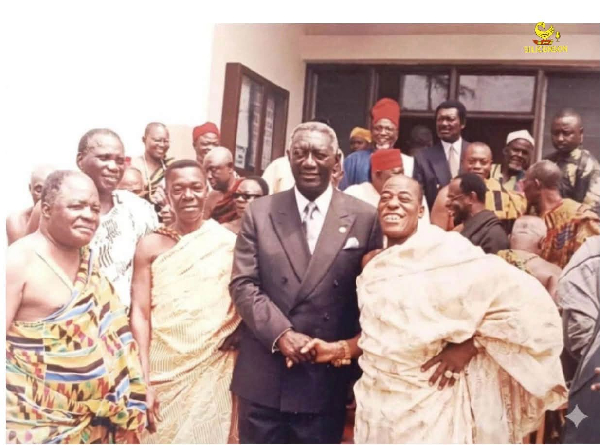
For Agogo, he was the Omanhene who led the traditional area for more than half a century. For Ghana, he was a lawyer, politician, minister, academic, farmer and statesman whose career extended well beyond the palace.
EA
General News of Saturday, 28 November 2026
Source: www.ghanaweb.com
How Agogomanhene became Chief, MP and Minister without abandoning politics
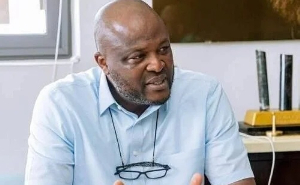
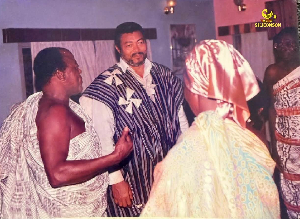 Agogomanhene with late Jerry John Rawlings at a function



Entertainment