The Deputy Commissioner of the Commission on Human Rights and Administrative Justice (CHRAJ), Mercy Larbi, has raised concerns over the emergence of pregnancy-driven cohabitation, warning that the practice is becoming a new form of child marriage in Ghana.
According to her, some families now arrange for girls who become pregnant before the age of 18 to live with the men responsible for the pregnancies, or with their families, rather than going through the traditional forms of marriage.
Speaking in a media interview during the commemoration of the International Day for the Elimination of Child, Early and Forced Marriage and the launch of key publications under the theme ‘Empower the Girl, Uphold Their Rights and Secure Their Future’, she said the trend requires urgent attention from policymakers and stakeholders.
Larbi explained that although Ghana has made progress in tackling child marriage, the nature of the practice appears to be changing, with pregnancy-driven cohabitation emerging as a worrying concern.
“What we’ve seen is that people are not reporting. When you look at the study that we’ve done, I must say that now the focus is shifting from the former marriage that we’ve seen to pregnancy-driven cohabitation.
“So the child gets pregnant, and the family will give the child to the one who impregnated her or to the family of the gentleman who impregnated her, and they will start a union. So it’s like it has drifted from the normal marriage that we see to this kind of relationship that is happening. That is the cohabitation issue. And it’s still a criminal offence,” she said.
She stressed that child marriage remains a criminal offence under Ghana’s laws, noting that the Children’s Act and the Criminal Offences Act prohibit the practice.
According to her, anyone below the age of 18 is considered a child, and therefore cannot legally be given away in marriage.
Larbi consequently called for amendments to the Children’s Act or the introduction of specific policies to address pregnancy-driven cohabitation and other emerging forms of child marriage.
She further maintained that cultural, religious and social beliefs cannot be used to justify child, early and forced marriages, pointing to international and regional human rights conventions that prohibit the practice.
The CHRAJ Deputy Commissioner identified poverty as one of the major factors driving child marriage, explaining that some families view the practice as a means of easing their economic difficulties.
She therefore called for stronger economic support and empowerment programmes for vulnerable families, particularly through the Livelihood Empowerment Against Poverty (LEAP) programme.
Larbi questioned whether girls at risk of child marriage were benefiting from such interventions, urging the government to pay attention not only to the availability of social protection programmes but also to how the support is distributed.
She insisted that Ghana must intensify efforts to address the underlying causes of child marriage while adapting its interventions to tackle emerging practices that threaten the rights and future of young girls.
“The main cause is poverty. And some family members are using it as a way of economic relief. So can we look at empowering these people because poverty is a human rights issue, and the government has a responsibility to look at these areas.
“The government has done a lot. We have the LEAP, but we have to look at how it's being disbursed. Are these girls part of this LEAP distribution? So we have to also look at that area. You cannot justify it with any culture or whatever religion or social status. You can't justify early or child marriage,” she added.
Adding to the concerns raised by CHRAJ Deputy Commissioner Mercy Larbi, Sexual and Reproductive Health and Gender Team Lead at UNFPA Ghana, Dr Doris Mawuse Aglobitse, has warned that the rise in pregnancy-related cohabitation and other informal unions involving adolescents could undermine Ghana’s efforts to eliminate child marriage.
Speaking at the event, she disclosed that although the prevalence of child marriage in Ghana had declined from about 40 per cent in the 1980s to 16.1 per cent in 2022, one in every six girls is still married or in an informal union before turning 18.
She further noted that the situation varies across regions, with the North East Region recording 31.6 per cent compared to 9.5 per cent in Greater Accra. Dr Aglobitse said poverty, weak law enforcement and limited public awareness continue to drive the practice, urging stakeholders to broaden their interventions to include informal unions that often go unreported.
She stressed that efforts to end child marriage must go beyond declarations and translate into tangible action to protect girls’ rights, education, health and future opportunities.
General News of Saturday, 28 November 2026
Source: www.ghanaweb.com
‘Pregnancy-driven cohabitation is replacing child marriage’ - CHRAJ Deputy Commissioner raises alarm
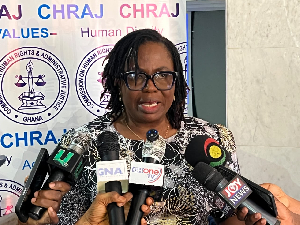 Mercy Larbi is the Deputy Commissioner of CHRAJ