The Chief Executive Officer of the Ghana Gold Board (GoldBod), Sammy Gyamfi Esq., has called for a new investment pact between Africa’s mineral sector and global capital, anchored on the principle of “Fair Return for Fair Value,” as a means to drive economic transformation and curb youth unemployment across the continent.
Addressing delegates at the Ambition Africa forum in Paris under the theme “Africa’s Minerals, Africa’s Future – A New Pact for Investment, Economic Transformation and Shared Prosperity,” Gyamfi said Africa faces a structural paradox: vast natural wealth beneath the ground alongside millions of young people struggling to find formal employment.
”These young Africans are Africa’s greatest resource. Yet each year, 10 to 12 million of them enter the labour market, while only about 3 million formal jobs are created,” he said, noting that youth unemployment stems from a production deficit marked by too few scaled firms, limited domestic value addition, and insufficient patient capital.
Highlighting Ghana’s experience under President John Dramani Mahama’s administration, Gyamfi pointed to historical leakages in the Artisanal and Small-Scale Mining (ASM) sector, citing a SWISSAID analysis that identified a 229-tonne gap, valued at US$11.4 billion, between Ghana’s reported gold exports and partner-declared imports from 2019 to 2023.
According to Gyamfi, formal ASM gold exports under the GoldBod framework rose from 63 tonnes in 2024 to 104 tonnes in 2025, generating roughly US10.8 billion. Between January 1 and October 20, 2026, the GoldBod recorded a further 85.4 tonnes in exports worth US11.6 billion, positioning the initiative as a central pillar of Ghana’s economic reset over the past 23 months.
”The GoldBod did not manufacture gold that did not exist. What we have achieved so far is a production clawback: bringing into the formal economy gold that was already being produced, but was being lost to smuggling,” he stated.
With international gold prices experiencing downward pressure, Gyamfi argued that producing nations cannot control global prices but can determine how much value and productive capacity they retain domestically. He reported that roughly 27 tonnes of ASM gold have been refined locally in Ghana in 2026 under the GoldBod initiative, while related reforms have created 5,000 direct jobs.
Looking ahead, Gyamfi invited investors to partner on the Ghana Gold Souk initiative starting in 2027 to establish a domestic jewelry manufacturing and fabrication hub. He also outlined opportunities in responsible mining, mercury-free processing, refining, and trading that support job creation and technology transfer.
While affirming that investors deserve competitive returns backed by a conducive business climate, Gyamfi stressed that Africa’s relationship with global partners, particularly Europe, must move beyond exporting raw materials in exchange for finished goods.
”History will judge us not only by the tonnes we extracted or the huge profit we recorded on our books or in our bank accounts. History will judge us by what we built with them: the industries, the opportunities, the enterprises and the communities,” he concluded.
Business News of Friday, 27 November 2026
Source: businesspostonline.com
GoldBod CEO advocates fairer returns on Africa's mineral resources
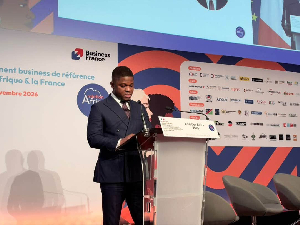 Sammy Gyamfi is the CEO of GoldBod