The country's working-age population grew by 3.7 million between 2012 and 2024 but the economy created only 435,000 net jobs over the same period, according to new World Bank Group (WBG) analysis.
The figures, from WBG's upcoming Country Growth and Jobs Diagnostic, were presented in Accra at the Ghana pilot launch under the second phase of the G20 Compact with Africa (CwA 2.0). They work out to roughly one net job for every eight or nine people who reached working age in the period.
This is just too few companies to grow and generate jobs at scale. The challenge is of both scale and quality," said Leonardo lacovone, Practice Manager for E Finance, Competition and Investment-World Bank.
lacovone said the economy has grown in most years of the past decade, but the pattern of growth has done little to move workers into better jobs. Only 13 percent of growth came from productivity gains linked to workers moving into better jobs, he said, against about a third on average in other countries.
He added that manufacturing, which is usually the main route from farm work into higher-paying jobs, accounts for only 16 percent of employment. Foreign direct investment (FDI) has hovered between 1.5 and 2.5 percent of gross domestic product (GDP) and credit is about 9 percent of GDP, which he described as insufficient for firms to scale up and hire.
So, the idea of this programme is really to try and contribute, working together with government and counterparts to address this challenge," Mr. Iacovone noted.
Robert Taliercio, Division Director-World Bank, said the diagnostic - due early next year points to a gap in the middle of the business landscape rather than a shortage of entrepreneurs.
Our finding, based on the ongoing country growth and jobs report, suggests that the main obstacle for Ghanaian firms is not creation but growth and scale," he said.
He listed the constraints holding firms back as regulatory uncertainty, high trade and logistics costs, limited access to finance and difficulty meeting the standards of regional and global markets. Micro-, small-and medium-sized enterprises (MSMEs) are the hardest hit.
WBG estimates the pilot could attract US$245million in private investment through four work streams covering trade policy, the investment climate, TransVolta Logistics Network and competitiveness of garment and light-manufacturing firms.
Jacovone said the garment sector shows how much potential is going unused. Exports could grow up to 43-fold and add as much as US$1.5billion, but firms first need better management, workplace practices and labour standards to meet buyers' requirements.
The jobs gap is reflected in official labour data. According to Ghana Statistical Service (GSS), youth unemployment reached 21.9 percent, nearly double the national average of 12.8 percent, over the first three quarters of 2025. For those aged 15 to 24, GSS put the rate at 32.4 percent over the same period.
The pressure is global.
The International Labour Organisation
(ILO) reported that the global youth unemployment rate rose to 12.4 percent in 2025, equivalent to 67 million unemployed people aged 15 to 24. It warned that in sub-Saharan Africa, rapidly growing youth populations outpace the creation of decent jobs - increasing the number of young people outside work and education.
The Minister for Trade, Agribusiness and Industry, Elizabeth Ofosu-Adjare, said government's response is to move the economy into processing and manufacturing.
She said her ministry measures progress by more investment in production, more local products sold a home and abroad and more jobs created as firms grow.
Our task is to move Ghana from exporting raw commodities to producing and exporting processed, competitive goods," she stated.
Under the approved textiles and garments sector policy, the ministry is establishing garment factories in four regions - projected to create 80,000 direct jobs, mainly for young people and women.
"If you are able to meet buyers and if you are able to secure larger export orders, it will go a long way to helping us," she said.
Dr. Bärbel Kofler, Germany's Deputy Minister for Economic Cooperation and Development and Parliamentary Secretary of State, said the quality of jobs matters as much as the number.
"It's of utmost importance that decent jobs are created on this continent and give a perspective to so many skilled young people" she said.
She urged investors to back women entrepreneurs. "No society can afford to leave 50 percent of their population behind, so please invest in women," she said.
Business News of Friday, 27 November 2026
Source: thebftonline.com
3.7m new workers, only 435,000 jobs in 12 years — World Bank
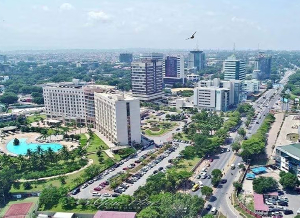 A screenshot of Accra central