November 27, 1924, remains a notable date in the history of Denkyira, marking a chieftaincy dispute that exposed deep divisions within the traditional authority structure and eventually resulted in a prison sentence for one of its chiefs.
The dispute centred on Kwabena Agyeman, who was destooled as Buabensohene, a divisional chief in the Denkyira traditional state. Rather than surrender the traditional stool after his removal, Agyeman reportedly took it away and refused to return it, setting off a dispute that would have consequences beyond his position as a chief.
According to historian John Abbam Nyarko's research, From a Kingdom to a Commonwealth: A History of Denkyira, 1500–1950, Agyeman was convicted and sentenced to one year in prison for failing to restore the Buabinso stool.
The account places the incident within a wider period of political tension in Denkyira, when traditional leaders increasingly challenged the authority of the Omanhene, the paramount ruler of the traditional state.
The episode was not simply about a chief refusing to give up a traditional symbol. It reflected a larger struggle over who had the authority to appoint, remove and exercise control over traditional officeholders in Denkyira.
The power struggle behind the stool dispute
To understand the significance of the November 1924 incident, it is important to look at the political position of Denkyira at the time.
Denkyira was once one of the most powerful Akan states in the Gold Coast. Its influence grew considerably during the 17th century, when it controlled important territories and trade networks. Its defeat by Asante in 1701, however, did not bring an end to its political and cultural significance.
Historian John Abbam Nyarko argues in his 2025 study that Denkyira continued to adapt to changing political circumstances after its defeat, retaining its identity and influence under both Asante and British colonial rule.
By the early 20th century, however, internal divisions and disagreements over traditional authority had become increasingly difficult to contain.
One major source of tension was the growing independence of local chiefs and village heads, some of whom no longer accepted the authority of the Denkyirahene without question.
Nyarko's research traces an important development to November 13, 1920, when village heads, known as Adikrofo, destooled Kwamin Enyimadu, the then Buabensohene. Kwabena Agyeman succeeded him but was himself destooled on November 27, 1924.
Agyeman's refusal to return the stool after his removal became one of the clearest examples of the growing confrontation between divisional chiefs and the paramount authority.
The consequences also extended beyond the immediate dispute. The incident became part of a prolonged breakdown in relations between the Buabinso leadership and the Denkyira paramountcy.
By 1929, the Buabensohene had declared independence from Denkyira following a prolonged dispute that had lasted more than eight years, according to Nyarko's historical account.
A dispute that exposed a weakening traditional authority
The Buabinso stool dispute also reflected the wider difficulties facing Denkyira's traditional leadership during the colonial period.
British colonial administration had introduced new channels through which local leaders and residents could challenge decisions made by traditional authorities. The Head Chief's Court Ordinance of 1910, for instance, allowed people to appeal decisions of an Omanhene at the District Commissioner's Office.
This development weakened the exclusive judicial authority of traditional rulers and gave dissatisfied local leaders another avenue through which to pursue their grievances.
The administrative division of Denkyira also complicated matters. Upper and Lower Denkyira fell under different colonial administrative arrangements, making it easier for some communities to deal directly with colonial officials rather than through the Denkyirahene.
These changes contributed to a gradual erosion of the paramount ruler's authority.
The Buabinso dispute was therefore part of a much larger political contest. It raised difficult questions about the limits of a chief's authority, the independence of divisional leaders and the power of the paramount stool to determine who could occupy traditional office.
When a stool became a symbol of resistance
One particularly interesting aspect of the episode is the significance of the stool itself.
In Akan traditional governance, a stool is not merely a seat or an item of furniture. It represents traditional office, legitimacy, authority and the continuity of leadership. Occupying a stool carries responsibilities and connects its holder to the history and customs of the community.
This explains why the refusal to surrender the Buabinso stool was more consequential than an ordinary disagreement over property.
Agyeman's reported actions brought the question of traditional legitimacy into direct confrontation with the authority responsible for recognising and regulating chieftaincy positions.
His one-year prison sentence also demonstrated how a traditional dispute could extend into the colonial judicial system.
There is, however, an important distinction in the historical account: November 27, 1924, is identified as the date of Agyeman's destoolment, while his conviction and prison sentence are described as subsequent consequences. The available account does not establish that he was sentenced on that same day.
A legacy beyond one chief
The dispute did not end with Agyeman's removal or imprisonment. Relations between Buabinso and the Denkyira paramountcy continued to deteriorate.
In 1929, the Buabensohene declared independence from Denkyira after years of disagreement. The dispute over the stool had become part of a much wider struggle over the political future of the traditional state.
In his study, Nyarko uses these developments to challenge the idea that Denkyira simply faded into history after its defeat by Asante in 1701. Instead, he presents a traditional state that continued to negotiate its position, preserve its identity and respond to changing political forces well into the colonial period.
More than a century later, the story of Kwabena Agyeman offers an unusual perspective on Ghana's traditional political history.
It is a reminder that the history of chieftaincy is not only about royal successions, celebrated reigns and ceremonial occasions. It is also shaped by disagreements over authority, contested leadership and the consequences of refusing to surrender power.
On November 27, 1924, a dispute over the Buabinso stool became another chapter in Denkyira's long struggle over traditional authority.
EA
General News of Friday, 27 November 2026
Source: www.ghanaweb.com
Today in History: The Denkyira chief who lost his stool and ended up in prison
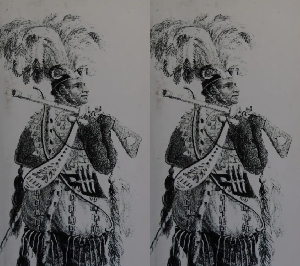 A file photo of Denkyira Chief