Foreign couples are increasingly travelling to Ghana to have children through surrogacy because the process costs significantly less than in countries such as the United States.
A report by Dutch television programme Nieuwsuur, on November 19, 2026, found that surrogacy arrangements in Ghana cost between $43,000 and $65,000, compared with up to $215,000 in the United States.
Woman opens up on emotional reality of surrogacy journey
The report said at least six Dutch couples had chosen Ghana for surrogacy over the past two years. A French man identified as Steven had also travelled to the country after strict laws in France limited his options.
However, the growing interest in Ghana has raised concerns about the welfare and rights of local women who serve as surrogate mothers.
According to the investigation, Ghana has become an attractive destination because of its relatively low costs and the range of options offered by local surrogacy agencies.
Some agencies advertise services that include immediate access to surrogate mothers, the selection of a baby's sex and the possibility of having twins.
The report cited a brochure from Afrigha Surrogacy, which offers different packages costing between €40,000 and €60,000.
Of this amount, the Ghanaian woman carrying the pregnancy receives about €6,000, which is equivalent to roughly one and a half times the average annual salary in Ghana.
Nieuwsuur reported that more than 40 babies had been born through the company's arrangements for American and European couples over the past two years.
The investigation also identified Ghana's legal arrangements as another reason foreign couples choose the country.
Susan Kibler, director of the surrogacy agency Delivering Dreams, told the programme that a Ghanaian court could recognise intended parents as the legal parents of a child during pregnancy.
This means the surrogate mother would no longer have parental rights over the child once the court order takes effect.
Despite the financial opportunities, the investigation raised concerns about the conditions under which some Ghanaian women carry pregnancies for foreign couples.
It found that some agencies require surrogate mothers to stay in accommodation provided by the companies throughout their pregnancies, keeping them away from their families.
The report also raised questions about their control over medical decisions, including whether a pregnancy should be terminated if abnormalities are detected.
According to the investigation, such decisions are often left to the intended parents and doctors, while communication between the surrogate mothers and prospective parents is monitored by the agencies.
Professor of Family Law at Leiden University, Kartica van der Zon, warned that the commercial nature of the industry could undermine the rights of the women involved.
"It is a market where more and more is possible. As long as you pay. Women are reduced to a means to bear a child. Their self-determination is taken away from them,” she said.
The report further noted that Ghana does not have specific legislation to protect surrogate mothers.
The investigation also found that some Ghanaian agencies allow prospective parents to select the sex of their babies, a practice prohibited in the Netherlands.
Afrigha Surrogacy was also reported to have offered a guarantee of a "living baby" as part of its packages.
The report also examined a proposed law in the Netherlands intended to make surrogacy easier to regulate and allow prospective parents to obtain legal parenthood more quickly.
Here is how much a surrogate mother can earn in Ghana
However, experts fear the legislation could encourage more couples to seek surrogacy services abroad, including in Ghana.
Meanwhile, Nieuwsuur said it contacted the director of Afrigha Surrogacy several times for a response to the concerns raised in the investigation, but the director declined to comment.
MAG/EB
Who Is Responsible for Stray-Bullet Injuries and Deaths?
General News of Friday, 27 November 2026
Source: www.ghanaweb.com
$215,000 in US, $65,000 in Ghana: Why Dutch couples are travelling to Ghana for surrogacy
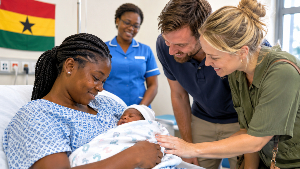 An illustrative image of a Ghanaian surrogate mother with a newborn baby and a foreign couple