Ghanaians are using instant bank transfers for much bigger payments than a year ago. The average transfer on the national instant payment system has risen by almost half in twelve months, a sign that higher-value payments are moving onto the platform.
Data in the Bank of Ghana’s Summary of Economic and Financial Data for November 2026 show that the value of transactions on GhIPSS Instant Pay (GIP) reached GH¢107.7 billion in October 2026, up from GH¢70.3 billion in October 2025. That is an increase of 53 per cent.
The number of transfers barely moved. GIP processed 18.35 million transactions in October, compared with 17.55 million a year earlier, a rise of just 4.6 per cent.
Analysis by the Economy Times shows that the average value of an instant transfer has therefore climbed from about GH¢4,007 to about GH¢5,871, an increase of 46 per cent. Inflation was 5.5 per cent over the same period, so most of that rise reflects larger payments in real terms, not just higher prices. The growth is coming from bigger payments, not more users.
That pattern points to a change in how the system is used. Instant transfers move money between accounts in seconds. A rising average ticket suggests the platform is increasingly being used for larger, business-type payments that once went through cheques or slower clearing channels.
The trend is not a one-month spike. GIP’s monthly value has risen in most months of 2026, from GH¢65.1 billion in February to above GH¢90 billion in every month since July, before reaching October’s high.
Mobile money still dominates by number of transactions, but the gap in value is narrowing. Mobile money handled 1.09 billion transactions worth GH¢552.1 billion in October, so its average transaction was about GH¢505. Instant Pay handled less than 2 per cent as many transactions as mobile money, yet carried about 20 per cent of its value. In effect, mobile money is the country’s channel for small, frequent payments, while instant bank transfers are becoming its channel for large ones.
The same data show an unexplained break in internet banking. Internet banking transactions fell from 4.76 million in February to 1.57 million in March, and have stayed between 1.1 million and 1.6 million a month since. In October, volume was 1.31 million, about 72 per cent below the 4.74 million recorded a year earlier.
Yet the value of internet banking payments hardly changed. It was GH¢38.5 billion in October, against GH¢41.7 billion a year earlier. The average internet banking transaction has therefore jumped from about GH¢8,800 to about GH¢29,500.
The Bank’s tables carry no note explaining the March drop. The sharpness of the fall suggests either a change in how transactions are classified or a mass shift of smaller retail payments to other channels, such as mobile apps and instant transfers. Either way, internet banking now records far fewer, much larger transactions.
The wider payments data point in the same direction. Point-of-sale terminals rose from 17,292 in October 2025 to 27,183 in October 2026, an increase of 57 per cent. The number of ATMs fell slightly, from 2,274 to 2,264. Prepaid cards more than doubled, from 407,000 to 866,000. Transfers across mobile money networks and platforms, known as interoperability, rose 48 per cent in value to GH¢7.4 billion.
Cheques have not disappeared. Cleared cheques were worth GH¢38.9 billion in October, up 13 per cent on a year earlier. But that growth trails far behind instant transfers, which in October were worth almost three times as much as cheques.
Larger instant payments also raise the stakes for fraud. Transfers settle within seconds and are difficult to reverse, so each fraudulent or mistaken payment now carries a bigger potential loss. The Cyber Security Authority has put losses from cyber fraud at GH¢209.7 million between January and September 2026, which puts more weight on banks’ controls and customer verification as payment sizes grow.
Business News of Thursday, 26 November 2026
Source: economytimesnews.com
Instant bank transfers surge by 53% to GH¢107.7 billion
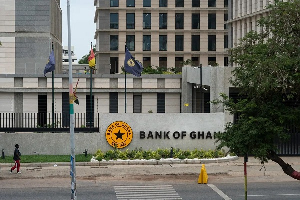 The Bank of Ghana (BoG) headquarters