Deputy Attorney General and Minister of Justice, Justice Srem Sai, has explained the implications of the Supreme Court's dismissal of an application challenging the order in which the accused persons in the $2 million Sky Train case are expected to present their defence.
The Supreme Court on Wednesday, November 25, 2026, unanimously dismissed an application by former Ghana Infrastructure Investment Fund (GIIF) Chief Executive Officer, Solomon Asamoah, challenging a High Court directive requiring him to testify before calling witnesses he intends to subpoena.
In a Facebook post on November 25, Justice Srem Sai said the ruling means the accused persons must testify before any individuals they intend to compel to appear as witnesses are called. He described the decision as significant because it allows the trial to proceed and gives the accused persons an opportunity to present their defence.
Providing a background to the ruling, he said the trial court, presided over by Justice Audrey Kocuvie-Tay, directed the two accused persons on July 2, 2026, to open their respective defences within 21 days. He said they defaulted twice and only filed their defence processes in the last week of September, following a third directive from the court.
According to him, neither accused person had identified witnesses to testify on their behalf when they opened their defences. However, Asamoah applied to have 15 individuals, including former Railway Development Minister Joe Ghartey and current and former GIIF officials, subpoenaed to testify for him.
Justice Srem Sai said the law requires an accused person seeking to compel witnesses to testify to indicate the general nature of the evidence those individuals are expected to give. He alleged that Asamoah's lawyers failed to provide the required information, submitting only 15 names and what he described as doubtful addresses.
The trial judge subsequently directed the accused persons to testify before the 15 individuals were compelled to appear. The defence challenged the directive, arguing that it infringed on Asamoah's constitutional rights to a fair trial and to remain silent.
However, the Supreme Court held that although an accused person has the right to determine how to conduct their defence, that right does not extend to controlling the proceedings of the court.
The five-member panel, presided over by Justice Issifu Omoro Tanko Amadu, held that the trial judge acted within the powers conferred on the court by Parliament. Justice Srem Sai explained that the Evidence Act expressly gives a trial court the power to determine the order in which witnesses are called and evidence is presented.
He further disclosed that the accused persons had filed at least seven applications seeking to stay proceedings before the High Court, Court of Appeal and Supreme Court, all of which had been dismissed. He also indicated that legal representation had been withdrawn twice during the trial.
Sky Train Trial: Court gives Asamoah two weeks to find new lawyer
With the latest ruling, the High Court can proceed with the trial, requiring the accused persons to testify before the individuals they intend to subpoena. Justice Srem Sai said the decision also gives them an opportunity to demonstrate why they should not be convicted.
Asamoah and former GIIF Board Chairman, Professor Christopher Ameyaw-Akumfi, are facing six counts, including conspiracy to wilfully cause financial loss to the state, wilfully causing financial loss to the state and intentionally dissipating public funds.
Below are the key points made by Justice Srem Sai in his explanation of the ruling:
CASE UPDATE: The Republic v Solomon Asamoah & Prof Christopher Ameyaw-Akumfi (Sky Train)
1. The 2nd Accused Person’s certiorari application was dismissed a while ago. This means that the Accused Persons will testify before any person who is subpoenaed may. A brief background to the dismissal:
2. On July 2, the trial Court directed the two Accused Persons to open their respective defences within 21 days. They defaulted twice and filed their defence processes in the last week of September, but only upon the third Court directive.
3. Upon opening their defences, none of the 2 gentlemen had any witnesses to testify for them - they are their own witnesses. The 1st Accused Person, however, applied to have 15 persons subpoenaed (forced) to testify for him.
4. Though the law requires an accused person to indicate the general nature of evidence which such forced persons will give, his lawyers gave no such indication. Just 15 bare names and doubtful addresses.
5. At the close of case management conference, the trial Court directed the Accused Persons to testify first before the 15 persons are forced to testify. They were dissatisfied with the trial Court’s ordering of witnesses, claiming that the Court has no such powers.
6. Their claim was, however, a misapprehension of the law. The Evidence Act expressly gives power to the trial Court to determine the order in which witnesses will be called and evidence adduced.
7. Nonetheless, the Accused Persons went ahead and filed an avalanche of processes in all available forums (the High Court, the Court of Appeal and the Supreme Court) seeking one single remedy - a stay of proceedings.
8. In all, not less than 7 applications for stay of proceedings have, since the beginning of this trial, been filed and dismissed in this case. Legal representation has been twice withdrawn.
9. This afternoon’s ruling is significant for 2 reasons: (1) it allows the trial to proceed and (2) offers an opportunity for the Accused Persons to show why they should not be convicted.
Da yie. See less
BAI
“We Like the Design, Release It Now” – Ghanaians React to New Currency Notes
General News of Wednesday, 25 November 2026
Source: www.ghanaweb.com
Dr Srem-Sai breaks down implications of Supreme Court ruling in $2 million Sky Train case
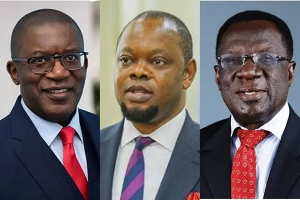 L-R: Solomon Asamoah, Justice Srem Sai and Christopher Ameyaw-Akumfi