The Bank of Ghana (BoG) has advised importers and exporters to make greater use of letters of credit and formal banking channels to ease payments and the repatriation of export earnings, as a pilot allowing businesses to pay Chinese suppliers directly from cedi accounts continues.
The Governor, Dr Johnson Pandit Asiama, gave the advice at the press briefing after the 133rd Monetary Policy Committee (MPC) meeting in Accra. He was responding to concerns that exporters of non-traditional products to China, including handicrafts, cashew, sheabutter and textiles, still struggle to bring their earnings home.
“Our advice to our importers is to, as much as possible, use letters of credit,” Dr Asiama said. “If you make use of the banks, you use the appropriate channels, it becomes easy to settle. It becomes easy for the exporters to repatriate.”
A letter of credit is a guarantee issued by a bank that a seller will be paid once agreed conditions are met. Because the payment runs through regulated banks, it reduces the risk of default and leaves a clear record of the transaction.
On the direct cedi-to-yuan arrangement, the Governor said the pilot led by Stanbic Bank was still running and that GCB Bank was also working on a similar service. “We are looking at the piloting that Stanbic is doing. If it works well, we will take it to the next level,” he said.
Stanbic Bank Ghana launched the service in August after receiving approval from the Bank of Ghana, becoming the first local bank with direct access to China’s Cross-Border Interbank Payment System(CIPS). Under the arrangement, eligible customers can initiate yuanpayments from their existing Ghana cedi accounts, subject to the bank’s requirements and applicable regulations. The Chinese supplier receives payment in yuan.
At the previous MPC briefing in September, the Governor said the shift was meant to end the practice of settling Ghana-China trade through a third currency. He explained that routing payments through the US dollar forces traders to convert twice and bear double the cost.
Dr Asiama said the effort was not entirely new. He recalled that under former Governor Dr Henry Kofi Wampah, the Bank arranged renminbi facilities to support Ghanaian importers. He added that the Pan-African Payment and Settlement System (PAPSS) also offers a route for direct settlement.
The Governor disclosed that the Bank’s work on cross-border payments goes well beyond China. “We are working with Nigeria, we are working with Rwanda, about an additional nine or ten countries in terms of facilitating cross-border trade,” he said. “That way, it becomes easier for our businessmen to do business with peers abroad.”
He did not say whether the BoG plans a currency swap agreement with the People’s Bank of China, a question raised at the briefing. He also did not say whether a direct cedi-yuan exchange rate would be set or whether pricing would still be derived from the US dollar.
For exporters, the problem raised at the briefing touches a wider concern for the economy: how much foreign exchange earned abroad actually returns to Ghana. Later in the same briefing, the Governor acknowledged a gap between the country’s strong trade surplus and the build-up of reserves, and said the BoG was examining how well it tracks foreign currency inflows.
Ghana recorded a trade surplus of US$13.0 billion between January and October 2026, yet gross international reserves fell to US$12.1 billion by November 17, from US$13.8 billion at the end of 2025. Pushing more trade payments through formal bank channels, including letters of credit and direct currency settlement, would give the central bank a clearer view of those flows.
The Governor said the BoG would continue to support efforts to make cross-border settlement easier for Ghanaian businesses.
Business News of Wednesday, 25 November 2026
Source: economytimesnews.com
BoG urges traders to use banks for international payments
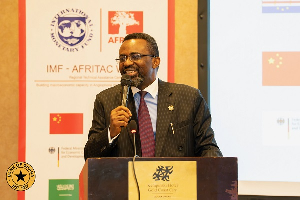 Dr Johnson Asiama is the Governor of Bank of Ghana