The Governor of the Bank of Ghana (BoG), Dr Johnson Pandit Asiama, says the rapid growth in bank lending has not yet reached a level that threatens the central bank’s ability to manage liquidity, despite a sharp rise in money supply over the past year.
Speaking at the press briefing after the 133rd Monetary Policy Committee (MPC) meeting at the Bank Square, Dr Asiama acknowledged that private sector credit had grown quickly but he said the Bank’s analysis showed the economy could still absorb more lending without spiking inflation.
“It is true that private sector credit growth has been quite rapid in the past one year, and also you see the monetary numbers going up,” he said. “However, from our assessments, from the analysis we looked at, the credit-to-GDP gap indicates that we still have space for accommodating some credit growth.”
“We haven’t reached the stage where private sector credit begins to have a negative impact by way of impacting on liquidity management. So for now, it’s under control,” he added.
The Governor was responding to a question on what the surge in credit and money supply means for the Bank’s need to sterilize excess cash through open market operations (OMO). Under these operations, the central bank issues short-term bills to absorb cedis from the banking system and pays interest on them.
The BoG’s own data show how quickly money has grown. Credit to the private sector grew by 37.2 per cent year-on-year in October 2026, up from 13.9 per cent a year earlier, and by 30 per cent in real terms. Broad money supply grew by 20.5 per cent, against 8.2 per cent a year earlier. Reserve money, the base on which bank lending is built, grew by 22.6 per cent, compared with 0.1 per cent over the same period.
Dr Asiama said the expansion should be seen against how little Ghanaian banks lend relative to the size of the economy. “As a ratio of GDP, private sector credit is a mere 8.8 per cent, way below that of Ghana’s peers,” he said.
“Kenya, for example, is doing probably nearly four times that. South Africa is doing probably six times that. Even our neighboring countries are doing way more than that,” he said. “So we are coming from a low base, and based on the numbers the committee was made to go through, we believe that at this stage, we can accommodate some more increase in private sector credit growth.”
Even so, sterilization has been costly for the BoG. Its 2025 financial statements show that it spent GH¢16.73 billion on OMO last year, nearly double the 2024 figure and its largest single expense, while the stock of sterilization bills almost tripled to about GH¢93.56 billion.
The Governor did not say how much of the sterilization burden is being eased by the BoG’s switch from a dynamic cash reserve ratio to a uniform one. Under a dynamic ratio, the share of deposits a bank must keep with the central bank varied with its lending. A uniform ratio applies the same requirement to every bank. Reserves held under the ratio earn no interest, while OMO bills do, so the choice between the two tools affects how much the BoG pays to keep liquidity in check.
The issue is likely to come into sharper focus in the coming weeks. Government’s voluntary buyback of up to GH¢28.58 billion in bonds maturing in February 2027 is due to settle on November 26, putting a large amount of cash in investors’ hands just as festive-season demand picks up.
At the same meeting, the MPC replaced its 14-day OMO instrument with a 7-day one and narrowed the policy corridor to plus or minus 100 basis points around the 11 per cent policy rate. The Governor said the changes put the Bank “in a better position to manage the liquidity impact” of such payments.
Business News of Wednesday, 25 November 2026
Source: economytimesnews.com
Ghana has room for more bank lending – BoG Governor
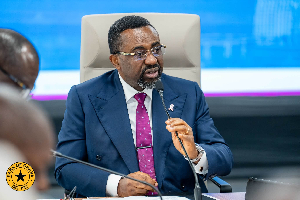 Dr Johnson Asiama is the Governor of Bank of Ghana