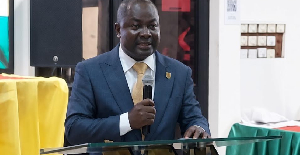
A US jury has convicted Betty Akamani of murdering her estranged husband, Ghanaian forestry professor Kofi Akamani, who was shot dead outside her home in Jackson County, Illinois.
The jury found the 35-year-old guilty on two counts of first-degree murder after deliberating for approximately one hour on Thursday.
She was also found guilty of endangering the life or health of a child. Betty Akamani could spend between 85 years and the rest of her life in prison. However, the date for her sentencing has not yet been announced, the Jackson County State’s Attorney’s Office said.
Prosecutors told the court that Betty Akamani shot her 48-year-old husband on September 19, 2026, shortly after he returned their two daughters following a scheduled visit.
The visit had included celebrations for one of the children's birthdays.
The trial lasted four days, with the prosecution presenting more than 160 pieces of evidence and calling about 20 witnesses to testify.
Throughout the proceedings, Betty Akamani maintained that she shot her husband in self-defence. Her lawyer argued that she believed he posed a danger to her and their children.
While testifying, Betty Akamani claimed she had seen her husband carrying a gun when he left the house. She also accused him of sexually exploiting their daughters in public toilets.
However, investigators told the court that their inquiries had found no evidence to support the accusations. They also confirmed that no gun was recovered from Kofi or his vehicle.
The prosecution relied heavily on surveillance footage from the house, which showed Betty Akamani firing at her husband from the porch before going inside to reload her weapon. She then returned and continued shooting while he was calling for help.
Prosecutors also questioned why she did not contact the police or take immediate action to protect her daughters if she genuinely believed they were in danger.
“Notably, even though the defendant made these allegations, she never called 911 nor intervened. Instead, she took herself out to eat at The Turn in Marion, where she ordered her final meal before killing Kofi Akamani,” a statement published by the Jackson County State’s Attorney's Office said.
During her closing argument, Assistant State’s Attorney Sophia Allen reminded the jury that the shooting happened while the couple's daughters were inside the house and their father was leaving the property.
“She did this while their girls were home, she did this while he was leaving the house, and she did this for no reason,” she told the jury.
What happened before the shooting?
Evidence presented during the trial showed that the Ghanaian professor, Kofi, had filed for divorce in February 2026. The separated couple had also agreed to a court-approved arrangement covering access to their two daughters.
On September 19, Kofi took the children to Texas Roadhouse in Marion to celebrate one of their birthdays.
They later went to Marion Carnegie Library and Starbucks before he returned them to their mother's home.
Betty Akamani told the court that she had also been in Marion that afternoon and had seen her husband at Texas Roadhouse.
US-based Ghanaian professor allegedly shot dead by wife – What we know so far
Betty claimed that some people approached her in the restaurant's car park and accused Kofi of sexually abusing their daughters in a bathroom.
Investigators, however, reviewed surveillance footage from the restaurant and library to verify the family's movements.
According to their testimony, the recordings did not show Kofi and the children entering a bathroom together. Their investigations also failed to produce evidence supporting the allegations.
The court also examined footage from The Turn, a restaurant and bar in Marion, where Betty went on the same afternoon.
Jackson County Sheriff's Office detective Brianna Hayes told the court that Betty spent about $120 on a meal that included filet, shrimp, salad and alcoholic drinks.
According to the detective, the footage showed Betty appearing relaxed and making very few checks on her phone.
The prosecution questioned why she had chosen to go out for a meal instead of reporting her husband's alleged behaviour to the police.
Another issue raised during the trial was Betty Akamani’s initial account of what happened. Investigators said she did not initially mention that Kofi had threatened her or was carrying a gun.
Her claim that she acted in self-defence reportedly emerged later during a phone conversation with her sister from Jackson County Jail.
In the recording played to the jury, Betty said she needed a lawyer who could help her establish a self-defence case.
Prosecutors argued that her comments suggested she was trying to build a legal defence rather than describing an immediate threat that forced her to shoot her husband.
Dispute over mail before the shooting
The court also heard details of a disagreement between the former couple over Kofi's mail.
Although they were no longer living together, Kofi continued to receive letters and other correspondence at Betty's residence.
Their daughters told the court that he usually entered the house after visitation to collect his mail.
Betty said she was caught off guard when Kofi entered the property on September 19. She described him as angry during their disagreement.
However, the children testified that they did not hear their father shouting.
She further claimed that she watched Kofi through a keyhole as he left and noticed what appeared to be a gun in his hand.
According to her account, he seemed to be pointing the object towards one of the children's bedrooms while walking towards his vehicle.
“I remember being super, super scared,” she told the court.
Her public defender, Celeste Korando, argued that Kofi had entered the property without permission and that Betty genuinely believed her life and those of her children were in danger.
She maintained that her client had reasonable grounds to use deadly force.
The prosecution rejected that explanation, pointing to the fact that investigators found no second firearm at the scene and that Betty only raised the self-defence argument later.
Daughters deny allegations against their father
The couple's two daughters also testified during the trial, with both rejecting claims that their father had sexually abused them.
One of the children recorded the shooting from a bedroom window. She told the court that she wanted to keep evidence that could help her father secure custody of them.
Under the court-approved parenting arrangement, Kofi was allowed to spend time with the girls on Wednesdays and Fridays, while they remained with their mother on the other days.
The jury also watched a recording of a forensic interview conducted with the other daughter by the Perry-Jackson Child Advocacy Centre after the shooting.
During the interview, the child was asked whether either of her parents had ever made her feel afraid or uncomfortable. She identified her mother.
She was also asked whether she expected anyone to do something like that to her father.
The child answered no and described him as “the nicest person on planet Earth”.
The court further heard that previous complaints of abuse against Kofi had been investigated by the police but were found to be unfounded.
Prosecutors traced the earlier complaints to 2017, when Betty discovered that her husband had a bank account she did not know about.
State Attorney reacts to guilty verdict
Jackson County State's Attorney Marsha Cascio-Hale described the conviction as an important step towards justice but said it could not erase the pain suffered by Kofi's family.
In a statement, Marsha Cascio-Hale said the couple's two daughters would have to grow up without their father and would continue to live with the consequences of their mother's actions.
“This verdict brings accountability for a devastating loss of life, but it cannot undo the heartbreak this tragedy has left behind. Two children will grow up without their father, and their lives have been forever changed by the actions of their mother. That is a loss no verdict can ever repair,” she said.
She expressed gratitude to the jury for carefully considering the evidence presented during the trial, adding that “there are no winners in a case like this”.
Cascio-Hale said her office remained committed to securing justice for victims and protecting the wider community.
She also dismissed the accusations Betty had made against her late husband, insisting that investigations had cleared his name.
“I do want to add that Kofi Akamani’s name is clean. Each of Ms Akamani’s claims was fully investigated, and there was not one shred of truth to what she alleged,” she said.
Angela Odom, Chief Executive Officer of the Survivor Empowerment Centre, a southern Illinois organisation that works to prevent domestic and sexual violence, also expressed concern about the impact of the incident on the children.
In the same statement released by the State Attorney's Office, she said the girls had suffered a painful loss after the actions of the person who was supposed to protect them.
“Our hearts are with the Akamani family, and especially their children. An adult whose responsibility was to protect them chose violence, and these children have now lost both of their parents,” she said.
Odom described the conviction as an important step towards justice for Kofi but noted that a court verdict alone could not address the trauma the children had experienced.
“They are survivors too, and as an organisation working to end domestic and sexual violence in Southern Illinois, we stand with them,” she added.
AK/AM
Godfred Nsiah Speaks on the Growth and Future of Jiu-Jitsu in Ashanti Region
General News of Wednesday, 25 November 2026
Source: www.ghanaweb.com