Professor Ato Quayson has called on Ghanaians to take a proactive stance against societal inequities, drawing inspiration from the courage of renowned Ghanaian philosopher Anton Wilhelm Amo, who challenged the injustices perpetrated against his people by Europeans.
He recounted how Amo spoke against the mistreatment of the people of Axim by the Dutch, an act of courage that reportedly led to his imprisonment and eventual death, which Prof. Quayson described as a form of martyrdom.
The Stanford University professor made these remarks at the 6th Anton Wilhelm Amo Public Lecture held at the University of Ghana on November 24, 2026.
The lecture, organised in collaboration with the Institute of African Studies and the Department of Philosophy and Classics, was held under the theme, “The Genesis of Doubt: From Anton Wilhelm Amo to Ghana’s Democracy.”
Speaking on Amo's intellectual and moral legacy, Prof. Quayson noted that despite spending a significant part of his life in Europe, Amo refused to accept second-class treatment and remained committed to standing up against injustice.
“The intellectual and moral commitments that defined his life. Even though, like Kwaku, he most likely did not speak his native Nzema after his lengthy sojourn in Europe, he refused to be treated as a second-class citizen either in Germany or on his return to his homeland.
“More importantly, his strong moral compass prevented him from remaining quiet when he witnessed the way that the Dutch were treating his people at Axim. He spoke up and was incarcerated, dying in what we must now recognise as a veritable form of martyrdom in protest against the cynical inequities imposed by the Europeans on his people,” he said.
Prof. Quayson added that Amo's example offers important lessons for contemporary society, particularly in understanding how doubt can be used to question established beliefs, challenge authority and promote democratic accountability.
He explained that the philosophical concept of doubt goes beyond fear and apprehension, extending to uncertainty about truth and reality.
“The second meaning, that is to say uncertainty about truth or reality, seems more pertinent to philosophy, while the first sense of fear, dread, and apprehension is more relevant to the expressions of doubt in various literary, and also biblical texts, as we shall see presently,” he noted.
Drawing on the works of French philosopher René Descartes, Prof. Quayson explained how systematic doubt became an important foundation of philosophical inquiry.
“One of the most famous instances of doubt in philosophy is provided by René Descartes, whom we encountered earlier, who set out systematically to doubt everything, including the evidence of his own senses, which he thought might sometimes be deceptive, and also the state of wakefulness as opposed to dreaming, given that some dreams felt quite real while sometimes reality itself appeared dreamlike. He famously settles on the cogito to argue that whoever doubts must be assumed to exist before they can doubt,” he explained.
Turning his attention to Ghana's democratic development, Prof. Quayson commended journalists and public commentators who have consistently spoken against wrongdoing and challenged political authorities without fear or favour.
He cited veteran journalist Kwesi Pratt Jnr, Manasseh Azure Awuni and academic Kwesi Yankah, among others, as individuals who have contributed to public accountability through fearless commentary and criticism.
“In Ghana, our journalists and commentators of the recent past and current times, such as Kwesi Pratt, Manasseh Azure, and so on, have acted as the welcome voices of civic conscience and have tackled knotty problems without fear or favour to either political tradition,” he said.
He also highlighted the contributions of satirical commentators Kwesi Yankah and Kwesi Opoku Acheampong, particularly through their respective columns, Abonsam Fireman and Shoes Are Repairing Here, during the 1980s and 1990s.
“Both of them showcased satirical commentaries in the 1980s and 1990s that, at the time, were undertaken at great risk to their persons. So these were very, very courageous satirists,” he added.
Prof. Quayson further argued that contemporary political commentators, including Kevin Taylor and Captain Smart, should also enjoy protection within a democratic society, despite the controversial nature of some of their commentary.
“But, contrastingly, the commentaries of people such as Kevin Taylor, Captain Smart, and various others in today's Ghana offer forms of political critique that arouse suspicion about the state and its functionaries. And yet, this is very important, within a democracy, even their form of commentary ought to be protected because they also represent the hallowed tradition of irreverence that is crucial for nurturing fearlessness about how to address the state and its functionaries,” he said.
He called for an environment in which journalists, commentators and other critical voices can freely question authority, regardless of their political leanings, arguing that such contributions are essential to strengthening democratic accountability.
Watch the public lecture below:
General News of Wednesday, 25 November 2026
Source: www.ghanaweb.com
Prof Ato Quayson urges Ghanaians to emulate Anton Wilhelm Amo in fighting injustice
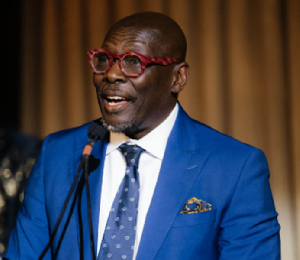 Ato Quayson is a professor at Stanford University.


Entertainment