Foreign Affairs Minister Samuel Okudzeto Ablakwa has donated GH¢50,000 to Stephanie Nkrumah, the Ghanaian woman who was allegedly assaulted by her employer in Iraq, following her safe return to Ghana.
Ablakwa also pledged to sponsor her education and ensure she receives free medical and psychological care as the government pursues diplomatic action against those responsible for the abuse.
The minister disclosed this after meeting Stephanie and her family on Monday, November 23, 2026, in Kumawu in the Ashanti Region, where they currently reside.
Stephanie came to public attention after a disturbing video circulated on social media showing her being subjected to what Mr Ablakwa described as a “violent and dehumanising assault” by her employer in Iraq.
According to the minister, she managed to escape from her attackers and return to Ghana with assistance from her family.
During the meeting, Mr Ablakwa said he listened to Stephanie's account of the incident and encouraged her to provide details about her alleged abusers and their network to help Ghana's diplomatic efforts to secure justice.
He disclosed that the government had formally lodged a protest with Iraqi authorities, demanding appropriate action over the assault.
The government is also considering a moratorium on the recruitment of domestic workers to Iraq, amid concerns that Stephanie's experience may not be an isolated incident.
Beyond the diplomatic intervention, the Foreign Affairs Minister said the government had arranged urgent medical treatment and clinical psychological support for Stephanie, following doctors' recommendations after her assessment.
He further disclosed that he had donated GH¢50,000 as initial financial assistance to help her establish a small business and become economically independent.
Mr Ablakwa also pledged to provide her with a scholarship to enable her to return to formal education, which she discontinued some years ago.
The minister reaffirmed the government's commitment to protecting Ghanaians living and working abroad, insisting that the safety and dignity of citizens would remain a priority for the Foreign Affairs Ministry and Ghana's diplomatic missions.
“As I keep insisting, an attack on any Ghanaian out there is an attack on all of us,” he stated.
He assured Stephanie of the government's support as she begins her recovery and seeks justice over the incident.
The development comes amid longstanding concerns about the treatment of Ghanaian domestic workers in parts of the Middle East, where some migrant workers have faced allegations of unpaid wages, passport confiscation, exploitation and physical abuse.
Background: Ghanaian domestic workers and abuse abroad
Stephanie's case has brought renewed attention to the risks faced by Ghanaians who travel abroad for domestic work, particularly in parts of the Middle East.
A 2023 International Organization for Migration (IOM) report on Ghanaian domestic workers in the Middle East traced the growth of labour migration to the region to the expansion of private recruitment agencies, including licensed and unlicensed operators.
The report cited Ghana Labour Department figures showing that the number of registered and licensed recruitment agencies increased from three in the mid-2000s to nearly 200 agencies recruiting workers domestically, alongside 43 agencies recruiting for overseas employment.
It also documented the use of informal intermediaries, popularly known as connection men, who assist prospective migrants with recruitment and travel arrangements. Such informal arrangements can expose jobseekers to exploitation and fraudulent recruitment practices.
More recently, the United States Department of State's 2024 Trafficking in Persons Report on Iraq identified migrant workers from Africa and Asia, including Ghanaians, among those vulnerable to forced labour.
The report documented cases involving the withholding of salaries, confiscation of passports, poor living conditions, threats of deportation and physical and emotional abuse by employers or recruitment agents.
It specifically noted an increase in Ghanaian domestic workers identified as trafficking victims in Iraq.
These concerns provide important context for Ghana's consideration of a possible moratorium on domestic worker recruitment to Iraq.
However, the proposed measure is still under consideration and should not be presented as an implemented ban. The government's diplomatic protest also does not, by itself, establish that the alleged perpetrators have been arrested or prosecuted.
For now, the focus remains on Stephanie's recovery, efforts to secure accountability and measures to prevent other Ghanaian workers from experiencing similar treatment.
The Foreign Affairs Ministry had earlier announced an investigation into the viral footage on November 17, 2026, when Mr Ablakwa appealed to the public for information that could help identify and locate the woman. He also promised a reward for credible information to support the investigation.
EA
General News of Tuesday, 24 November 2026
Source: www.ghanaweb.com
Ghanaian house-help assaulted in Iraq returns home as Ablakwa gives her GH¢50,000
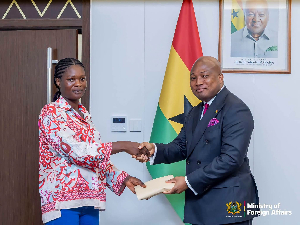 A picture showing the Foreign Affairs Minister Ablakwa presenting the money to Stephanie Nkrumah





Opinions