Forty-four years ago, Ghana was experiencing one of the most turbulent periods of its post-independence political history. On November 24, 1982, then Head of State, Flight Lieutenant Jerry John Rawlings, moved to tighten his government's grip on power following an attempted coup by soldiers the previous day.
The failed uprising on November 23 had exposed growing divisions within the Provisional National Defence Council (PNDC), barely a year after Rawlings returned to power through the December 31, 1981 coup.
In response, Rawlings announced a nationwide dusk-to-dawn curfew in a radio broadcast, ordered rebel soldiers to surrender and warned that those who refused would be dealt with severely.
The announcement followed hours of gunfire at military installations in Accra, particularly around Gondar Barracks at Burma Camp, where troops loyal to the PNDC managed to suppress the rebellion.
Historical reports published at the time described Rawlings as declaring that loyal troops had successfully defeated an attempt to overthrow his government. The authorities also announced the closure of Kotoka International Airport as security operations intensified.
But the government's response did not end with the suppression of the coup attempt. It also brought a dramatic crackdown on people within the revolutionary movement who were suspected of opposing Rawlings' leadership.
One of the most striking incidents occurred at the official residence of Zaya Yeebo, the PNDC Secretary for Youth and Sports. Historical accounts describe how Rawlings personally led a platoon of armed soldiers in a helicopter operation to the residence on November 24, where several activists and revolutionary cadres were arrested.
Among those reportedly caught up in the operation was Taata Kwadzo Ofosu, then Deputy Editor of the Workers' Banner. Other accounts of the incident also identify several figures associated with the National Defence Committee and the revolutionary movement.
The operation was particularly significant because some of the people targeted had been part of the political and grassroots mobilisation that accompanied the rise of the PNDC. Their arrest exposed the widening divisions within a movement that had initially presented itself as a united force for political and social transformation.
The crackdown was not simply a response to an external threat. It also reflected an internal struggle over the direction of the revolution, the concentration of political power and the future of the PNDC.
Research published by the World Bank in Aid and Reform in Africa explains that sections of the left-wing movement had become increasingly frustrated with Rawlings, believing he was abandoning the revolutionary ideals they had supported. The November 23 coup attempt provided the government with an opportunity to remove some of these dissenting elements. Several activists were arrested, while others went into exile.
The wider political context
On December 31, 1981, Rawlings led a military takeover that removed President Hilla Limann and his People's National Party (PNP) government. He subsequently established the PNDC, suspended the 1979 Constitution, dissolved Parliament and banned political parties.
The new administration presented itself as a revolutionary government committed to fighting corruption, tackling economic hardship and transferring political power to ordinary Ghanaians through grassroots structures.
However, the movement was never entirely united. Disagreements emerged over how the revolution should be managed, the extent of civilian participation and the government's economic direction.
By late 1982, some left-wing activists believed Rawlings was moving away from the revolutionary principles that had brought them together. There were also disagreements over proposals to engage international financial institutions, including the International Monetary Fund (IMF), to address Ghana's economic difficulties.
The November 23 coup attempt therefore came at a particularly sensitive moment for the PNDC. It was not merely a confrontation between government forces and rebellious soldiers; it exposed a deeper political struggle within the revolutionary establishment.
The crackdown also formed part of a broader period of political repression under military rule. The suspension of constitutional government, detention of political opponents and use of military and public tribunals became major features of the PNDC years.
Ghana's political history during this period was also marked by the June 30, 1982 abduction and murder of three High Court judges — Justices Cecilia Koranteng-Addow, Frederick Poku Sarkodie and Kwadjo Agyei Agyepong — alongside retired Army Major Samuel K. Amedume. The killings further deepened concerns about political violence and the abuse of state power.
The November 1982 coup attempt was not the last challenge to Rawlings' government. Another attempted coup was reported on February 27, 1983, while subsequent years also witnessed further alleged plots against the PNDC.
Why November 24 remains significant
The events of November 24, 1982, offer an important perspective on the contradictions of Ghana's revolutionary period.
Rawlings had come to power promising a new political order that would give ordinary people a greater voice in governance. Yet, less than a year into his second administration, the government was confronting opposition not only from rival soldiers but also from activists who had helped establish the revolutionary movement.
The curfew, military arrests and crackdown on suspected dissenters demonstrated how quickly revolutionary unity could give way to political suspicion and internal power struggles.
For Ghana, the episode remains an important reminder of the country's difficult journey through military interventions, political instability and the eventual restoration of constitutional democracy in 1993.
November 24, 1982, was therefore more than a day of heightened security following a failed coup. It was a moment that exposed the fractures within the PNDC and the increasingly complicated relationship between Rawlings and sections of the revolutionary movement that had helped bring him to power.
EA
General News of Tuesday, 24 November 2026
Source: www.ghanaweb.com
Today in History: Rawlings imposes curfew after failed coup, arrests left-wing activists
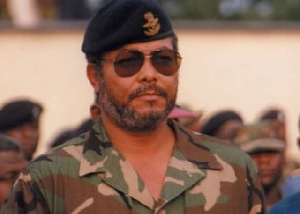 A picture of Jerry John Rawlings