Ghana’s first President, Dr Kwame Nkrumah, had a special way of communicating with his personal cameraman, Rev. Dr Chris Tsui Hesse, using his walking stick to give secret filming instructions.
Rev. Dr Hesse revealed that the walking stick was not used because Nkrumah had difficulty walking but served as a private communication tool between them during filming.
EXPLAINER: Here are four questions to consider before investing with GH¢100
He made the revelation in The Eyes of Ghana, a documentary directed by Ben Proudfoot, which tells the story of his career and his work documenting Ghana’s independence era.
According to Hesse, the two developed special signals that helped him know when to record an event and when to stop filming without the need for verbal instructions.
"He had a walking stick, not because he had a bad leg. We used the stick to talk. When he wanted me to film something, I knew; when he didn't, I knew," he recalled.
Hesse also disclosed that Nkrumah trusted him with the responsibility of documenting important moments in Ghana's history.
"My son, I'm depending on you as the filmmaker to tell the story," Nkrumah once told him, according to Hesse.
The veteran cinematographer served as Nkrumah's personal cameraman during the 1950s and 1960s, capturing major political events, presidential activities and moments from the wider African liberation movement.
He also recounted the challenges he faced while filming international events, saying he was sometimes the only Black cameraman present and had to fight for the best position to capture important moments.
Hesse's story was highlighted when The Eyes of Ghana was screened at the Kwame Nkrumah Memorial Park in Accra on Saturday, October 31, 2026.
The documentary also examines his efforts to preserve the historical footage he recorded during Nkrumah's presidency.
Following the 1966 coup that removed Nkrumah from power, much of the footage Hesse had recorded was destroyed.
However, he managed to preserve more than 1,000 reels of film in a personal archive in London.
The recordings provide a rare visual account of Ghana's independence, Nkrumah's leadership and Africa's struggle for liberation.
ANAS/EB
THE EYES OF GHANA
General News of Friday, 20 November 2026
Source: www.ghanaweb.com
How Nkrumah secretly directed his cameraman using a walking stick
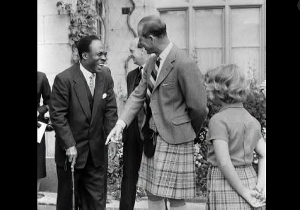 Dr Kwame Nkrumah is Ghana’s first President