The new Chancellor of the University of Media, Arts and Communication (UniMAC), Dr Ernest Ofori Sarpong, has raised concerns over the institution's infrastructure, saying it lacks the facilities required to match its historical contribution to media, arts and languages education in Ghana.
Addressing the university community at his investiture ceremony at the South Legon Campus in Accra on Friday, November 20, 2026, Dr Ofori Sarpong called for urgent investment in modern lecture theatres, television studios, digital media laboratories, language laboratories and research facilities to position the institution for global competitiveness.
He said the university must move beyond its existing limitations and create an environment capable of supporting quality teaching, research, innovation and the changing demands of the creative industry.
"In fact, UNIMAC does not currently have the required infrastructure buildings to commensurate with its historical contributions to media, arts, and languages development in Ghana," he stated.
Dr Ofori Sarpong, who becomes the university's first Chancellor, said his vision for the institution would rest on four major priorities: infrastructure and the learning environment; human resource development and emerging technologies; brand recognition and international standing; and industry collaboration and entrepreneurship.
Infrastructure and technology
On infrastructure, he urged the university to mobilise investment from government, corporate Ghana, development partners, alumni and philanthropists to improve its facilities.
He also called for attention to student accommodation, accessibility and the general campus experience, arguing that the university's ambitions must be reflected in the quality of the environment it provides for students and lecturers.
However, he stressed that physical infrastructure alone would not make UniMAC a great institution.
"Buildings alone do not make a university great—people do," he said.
He identified lecturers, researchers, administrators, technical support staff and students as the institution's most valuable resources, insisting that their professional development must remain a priority.
The Chancellor also called for increased investment in research, international collaborations and training to prepare the university community for changes in professional practice.
He specifically identified artificial intelligence (AI), digital communication and emerging creative technologies as developments reshaping the world of work.
"UNIMAC must ensure that its graduates are prepared for these changes without losing sight of ethics, critical thinking, and professional integrity," he said.
Wants UniMAC to become globally recognised
Dr Ofori Sarpong further called for a deliberate effort to establish UniMAC as a respected academic brand in Ghana, across Africa and internationally.
He said the university must communicate its achievements more effectively, strengthen relationships with reputable universities, pursue relevant international accreditations and improve its digital presence.
According to him, these measures would help position UniMAC as a university of choice for prospective students across the continent.
He also underscored the need for stronger collaboration between the university and the private sector, particularly media organisations, telecommunications companies, financial institutions and technology firms.
Drawing on his experience as an entrepreneur and chartered accountant, he said the university must develop a stronger culture of translating ideas and opportunities into practical outcomes.
"My experience in business and as a chartered accountant has taught me the importance of recognising potential, investing in people and ventures, and turning good ideas into practical results," he said.
He challenged the university to produce graduates who could establish businesses and create employment rather than depend solely on the traditional job market.
"Our graduates must prepare not only to seek jobs, but also to create them," he stated.
He cited the university's recent masterclass for bloggers and digital content creators as an example of initiatives that could help bridge the gap between academia and emerging professional fields.
He consequently appealed to corporate Ghana to regard UniMAC as a strategic partner in talent development, innovation and economic growth rather than merely an institution that produces graduates.
Calls for collective responsibility
Beyond the university's immediate development needs, Dr Ofori Sarpong said its long-term success would depend on the commitment of all stakeholders, including the Governing Council, Vice-Chancellor, management, faculty, staff, students, alumni and external partners.
He pledged to work with these groups to advance the university's vision, oversee the implementation of its strategic plans, strengthen institutional relationships and mobilise resources for sustainable development.
He also called for a culture of accountability, integrity, responsible management and continuous improvement.
"The future of UNIMAC is a shared responsibility," he said.
The Chancellor appealed to government, corporate Ghana, international partners and philanthropists to establish lasting partnerships with the university, particularly in infrastructure development, scholarships, research, entrepreneurship and professional training.
He also urged alumni not to abandon their former institutions following the merger that created UniMAC.
"To our alumni, your engagement with UNIMAC should not end at graduation, and do not dissociate yourselves simply because the old institution has given way to a new UNIMAC. Your experience and networks can open doors for future generations," he said.
A responsibility beyond the title
Reflecting on the significance of becoming the university's first Chancellor, Dr Ofori Sarpong said the appointment came with the responsibility of establishing standards that would guide future occupants of the office.
He described the opportunity as both a privilege and a demanding responsibility, noting that he had no established path to follow as the first person to occupy the position.
"The privilege of being the first is to help define the path and set standards worthy of international repute for those who will come after me," he said.
He added that his tenure would inevitably become a reference point for future expectations of the office.
Dr Ofori Sarpong also acknowledged the university's historical foundations, which bring together the Ghana Institute of Journalism (GIJ), the Ghana Institute of Languages (GIL) and the National Film and Television Institute (NAFTI).
He said his responsibility was to build on the traditions of the three institutions while ensuring that UniMAC became an institution capable of influencing the future of education, industry and society.
The University of Media, Arts and Communication was established under the University of Media, Arts and Communication Act, 2020 (Act 1059), which brought the three specialised institutions under one university structure.
Concluding his address, Dr Ofori Sarpong described the Chancellorship as a call to promote unity, collective purpose and responsible stewardship.
"The mantle of the chancellor is not merely one of honor. It is a call to nurture unity, cultivate collective purpose, and provide the wisdom and stewardship through which UNIMAC can withstand the winds of change and flourish," he said.
"The true measure of my chancellorship lies in the ever-growing strength of UNIMAC."
He expressed confidence that, through collective effort, the university could become a major force in shaping the future of media, arts and communication in Ghana, Africa and beyond.
"As a mighty tree of knowledge, creativity, and innovation, collectively and individually, we shall build a UNIMAC that will not merely participate in the future of media, arts, and communication, but help shape the future that Ghana, Africa, and the world needs," he concluded.
EA
General News of Friday, 20 November 2026
Source: www.ghanaweb.com
UniMAC lacks infrastructure befitting its legacy – Chancellor, Ernest Ofori Sarpong
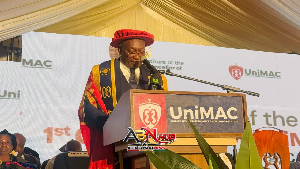 Photo of Dr Ernest Ofori Sarpong, First Chancellor of UniMAC