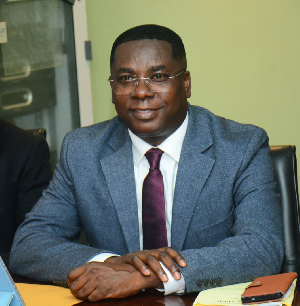
Minority Leader Alexander Afenyo-Markin has criticised the government’s decision to remove the collective portrait of the Big Six from Ghana’s newly unveiled banknotes, describing the move as a troubling attempt to rewrite the country’s history.
He argued that the decision, which retains only Ghana’s first President, Dr Kwame Nkrumah, among the Big Six, risks undermining the contributions of other key figures in the country’s struggle for independence.
In a Facebook post shared on November 15, 2026, Afenyo-Markin said the decision was particularly concerning as Ghana prepares to mark its 70th Independence Anniversary.
He maintained that the Big Six earned their place in Ghana’s history through their leadership in the independence struggle and their detention following the 1948 disturbances.
“The NPP did not invent the Big Six. Their place in history arose from their organised leadership in the struggle for independence and, specifically, the detention of six United Gold Coast Convention (UGCC) leaders following the 1948 disturbances,” he stated.
Afenyo-Markin noted that the Convention People's Party (CPP), which later led Ghana to independence, emerged from the UGCC in 1949, stressing that the contributions of the two political traditions were interconnected.
He further cited Nkrumah’s autobiography, in which the former president acknowledged the group and mentioned the other five members by name.
“The ‘Big Six’, as we came to be known,” Afenyo-Markin quoted Nkrumah as writing, adding sarcastically that “perhaps this government's historians should summon Nkrumah for questioning!”
Picture on new GH¢50 note is not Theodosia Okoh, that's my mother - Family member tells BoG
He recalled that the collective portrait of the Big Six was introduced on Ghana’s redenominated banknotes in 2007 under former President John Agyekum Kufuor and then Governor of the Bank of Ghana, Paul Acquah, during the country's Golden Jubilee celebrations.
He also pointed out that the introduction of the GH¢2 note bearing Nkrumah’s portrait alone under former President John Evans Atta Mills did not result in the removal of the Big Six from the other banknotes.
According to him, the development demonstrated that Ghana could honour individual historical figures without disregarding the contributions of others.
Afenyo-Markin welcomed the recognition of other prominent Ghanaians, including Theodosia Salome Okoh, Ephraim Amu and Kofi Annan, but questioned why their inclusion should come at the expense of the Big Six.
“Why must honouring more patriots require removing others? Is there a shortage of space on our currency, or a shortage of tolerance for the parts of our history that celebrate patriots the Mahama-led NDC does not like?” he questioned.
He also called for the recognition of other historical figures, including Chief Simon Diedong Dombo, whose Northern People's Party won 15 seats in the 1956 general election, giving northern interests a significant voice in the constitutional process leading to independence.
Afenyo-Markin highlighted the contributions of Otumfuo Sir Osei Agyeman Prempeh II, particularly his cooperation with J.B. Danquah in advancing a common constitutional framework for Asante and the Gold Coast Colony.
On the controversy surrounding the portrait of Theodosia Okoh on the new banknotes, Afenyo-Markin called on the Bank of Ghana to publish the photographs used in designing the image to address concerns raised by her family.
He referred to claims by her nephew, Dr Eddie Obeng, that the portrait bears a resemblance to his mother, Dr Letitia Obeng, rather than Okoh.
Afenyo-Markin said the central bank should engage the family transparently and make corrections if necessary, arguing that the woman who designed Ghana's national flag deserved an accurate representation.
He also accused the government of overlooking the contribution of J.B. Danquah, whom he credited with helping advance the adoption of the name Ghana for the independent Gold Coast.
He argued that national recognition should transcend political differences, urging President John Dramani Mahama to ensure that decisions concerning national symbols reflect the contributions of personalities from different political traditions.
“President Mahama must rise above the temptation to make national recognition an exercise in partisan selection. Our currency belongs to every Ghanaian. It should reflect the breadth of our history and the generosity of our national spirit,” he said.
He stressed that although the government could remove the Big Six from the country's currency, it could not erase their contributions from Ghana's historical record.
“To our historian leader, President John Dramani Mahama, your government can remove the Big Six from the currency, but can never withdraw them from history,” he added.
See the post below
MRA/BAI
Dr Cassiel Ato Forson presents the 2027 Budget Statement and Economic Policy
General News of Monday, 16 November 2026
Source: www.ghanaweb.com
Afenyo-Markin slams removal of Big Six from new currency notes
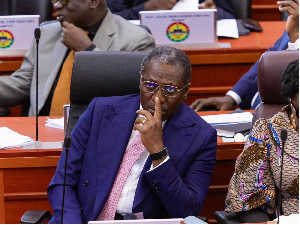 Alexander Afenyo-Markin is the Minority leader