The Minority in Parliament has challenged the Mahama administration to account for its flagship economic programmes, accusing the government of repackaging existing policies under new names while failing to provide clear evidence of their implementation and impact.
The Minority says the proposed US$10 billion New Economy programme, outlined in the 2027 Budget, bears striking similarities to the National Democratic Congress (NDC)’s 24-Hour Economy agenda, raising questions about what is genuinely new and how the government intends to finance the initiative.
Kojo Oppong Nkrumah, Ranking Member of Parliament’s Economy and Development Committee, argues that six of the eight pillars of the New Economy programme reportedly overlap with interventions previously announced under the 24-Hour Economy policy.
He has therefore challenged the government to explain the distinction between the two programmes and provide a detailed account of the projects, expenditure and jobs delivered under its earlier commitments.
The 24-Hour Economy policy was introduced with a target of creating 1.7 million jobs by 2028. However, Oppong Nkrumah says the government has yet to provide a satisfactory account of how many jobs have been created, which projects have been implemented and how much public money has been spent.
The Minority is also demanding answers on Ghana CARES (Obaatan Pa), the previous administration's GH¢100 billion economic recovery and transformation programme, arguing that successive governments must account for major economic interventions rather than introduce new policy labels without publishing clear implementation results.
The criticism also extends to the financing of the New Economy programme. Oppong Nkrumah has questioned the government's projected domestic financing requirements, estimated at about GH¢85 billion, and the decision to reduce the primary surplus target from 1.5 per cent to 0.5 per cent of Gross Domestic Product (GDP).
The government's 2027 Budget proposes to invest US$10 billion in the New Economy between 2027 and 2030, with GH¢30 billion earmarked for the first year. The eight pillars cover commercial agriculture, energy infrastructure, critical minerals, tourism and the creative arts, textiles and garments, pharmaceuticals and biomanufacturing, technology, and macroeconomic stability and affordable finance.
Finance Minister Dr Cassiel Ato Forson has explained that the programme is intended to expand domestic production, increase local processing of raw materials, create jobs and strengthen Ghanaian businesses. The government says it will finance the initiative partly through fiscal adjustments and revenue expected from tax reforms and improved compliance.
However, the Minority wants the government to demonstrate how the programme differs from existing policies and explain how its funding arrangements will protect the country's fiscal position.
Beyond the New Economy debate, the Minority has raised concerns about what it describes as a growing financial burden on ordinary Ghanaians under the 2027 Budget.
Mohammed Amin Adam, Ranking Member on Parliament's Finance Committee, says allocations for three major social intervention programmes — the Livelihood Empowerment Against Poverty (LEAP), the Ghana School Feeding Programme and the Capitation Grant — have fallen from GH¢3.46 billion in 2026 to GH¢2.26 billion in 2027.
The reduction of about 35 per cent, he argues, could affect support for vulnerable households, schoolchildren and families already struggling with the cost of living.
At the same time, he says projected revenue from fees and charges is expected to rise from GH¢1.3 billion to GH¢6.1 billion, an increase of approximately 354 per cent.
The Minority argues that although the government has maintained that it is not introducing new taxes, higher fees and charges could still increase the financial pressure on households and businesses.
The debt burden is another major concern. Amin Adam has questioned the allocation of approximately GH¢61 billion for interest payments, arguing that the amount exceeds the combined allocations for agriculture, energy, the Big Push infrastructure programme, youth development, industry and tourism, which total GH¢37.874 billion.
He has also drawn attention to the country's rising public debt, which increased from 44.7 per cent of GDP at the end of 2025 to 47.5 per cent by October 2026, despite the debt restructuring exercise.
The Finance Ministry's 2027 Budget confirms provisional public debt of GH¢759.3 billion at the end of October 2026, with domestic debt accounting for 56.4 per cent of the total.
The Minority's concerns also extend to several campaign and policy commitments it says remain unfulfilled, including the promised 800,000 jobs, the construction of three sports stadiums, the Agenda 111 hospital project and the proposed district-level banks for women.
It has also demanded an explanation for the more than GH¢450 million reportedly allocated to the proposed Women's Development Bank, asking what progress has been made towards establishing the institution.
The concerns have revived questions about the government's earlier economic interventions, particularly the 24-Hour Economy and Ghana CARES programmes.
The 24-Hour Economy and Accelerated Export Development Programme was officially launched in July 2025, with a target of creating more than 1.7 million jobs by 2028. Its policy framework focuses on transforming production, improving supply chains and market access, and developing human capital. The government has subsequently reported projects and agreements under the initiative, including an investment pipeline valued at US$11.5 billion.
Ghana CARES, also known as Obaatan Pa, was launched in November 2020 as a GH¢100 billion, three-and-a-half-year economic recovery and transformation programme following the COVID-19 pandemic. Its priorities included commercial agriculture, light manufacturing, pharmaceuticals, textiles, digitalisation, housing and construction.
Oppong Nkrumah says the government must provide a clear account of the resources committed to such programmes and the results achieved before asking Ghanaians to embrace another major economic initiative.
He has warned that the Minority will pursue alternative accountability mechanisms if the Finance Minister fails to account for public funds received and spent.
He has also announced plans to introduce a Private Member's Bill to strengthen Parliament's oversight of public expenditure.
The Minority says it will continue scrutinising the 2027 Budget and demand explanations from the government on its spending priorities, employment promises, social protection allocations and economic transformation plans.
EA
General News of Sunday, 15 November 2026
Source: www.ghanaweb.com
Minority tears into Mahama's new economy, 24-hour agenda
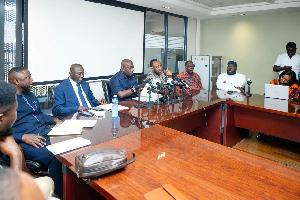 A photo of some members of the Minority holding a press conference