Government is targeting GH¢310.8 billion in domestic revenue in 2027 despite its decision not to introduce new taxes, placing greater pressure on existing revenue collection systems to generate funds for its development programmes.
The target is contained in the 2027 Budget's revenue projections, which estimate total revenue and grants at GH¢314 billion, equivalent to 17.3 per cent of Gross Domestic Product (GDP).
Gross non-oil tax revenue is expected to contribute GH¢264.3 billion, indicating that government will rely heavily on existing tax sources to meet its financing needs.
2027 Budget: Key issues raised ahead of today's presentation
Deputy Finance Minister Thomas Nyarko Ampem has indicated that government will not introduce new taxes in the 2027 Budget. Instead, it plans to mobilise the required funds through improved revenue collection, expenditure rationalisation and savings from cuts in public spending.
The strategy is expected to focus on improving tax compliance, strengthening customs administration, broadening the tax base and plugging revenue leakages.
However, government will also have to manage significant spending commitments. Compensation of employees is projected at GH¢104.1 billion, while capital expenditure is estimated at GH¢89.7 billion. Grants to other government units are expected to reach GH¢76.3 billion, with interest payments accounting for another GH¢61.3 billion.
These projections highlight the challenge of generating enough revenue to meet government obligations while sustaining investment in infrastructure and other development projects.
The Big Push infrastructure programme is among the initiatives expected to receive significant funding, with an allocation of GH¢27.5 billion from domestic resources and the Annual Budget Funding Amount.
Other priority areas include commercial agriculture, agribusiness, energy, critical minerals, textiles and garments, tourism, creative arts and pharmaceutical manufacturing.
Government is also expected to outline funding arrangements for the 24-Hour Economy and the Gold Refining Initiative, which aims to ensure the local refining of at least one metric tonne of gold every week.
The 2027 Budget also provides for public financial management reforms, including plans to make the Fiscal Council fully operational from 2027 and restore uncapped statutory transfers to the National Health Insurance Scheme, GETFund, the Road Maintenance Trust Fund and the Ghana National Petroleum Corporation.
The key test will be whether government can meet its GH¢310.8 billion domestic revenue target without introducing new taxes, while fulfilling its spending commitments and delivering on its development promises.
ANAS/MA
Women’s Development Bank to Improve Access to Finance for Women – Veep
Business News of Thursday, 12 November 2026
Source: www.ghanaweb.com
Government targets GH¢310.8 billion revenue without introducing new taxes
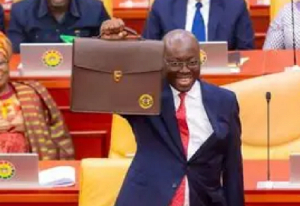 Dr Cassiel Ato Forson is set to present the 2027 budget in parliament today