November 10 carries two significant chapters in Ghana's political history: the bombing of Kwame Nkrumah's residence in 1955 and Britain's rejection of proposals to divide the Gold Coast a year later.
The two events, separated by exactly 12 months, capture a turbulent period in the country's struggle for independence, when political divisions, regional tensions and disagreements over the structure of the future nation threatened to derail the march towards self-government.
They also offer a glimpse into the difficult political circumstances under which Ghana's founding leader, Dr Kwame Nkrumah, pursued independence and the eventual creation of a united Ghana.
The night explosives rocked Nkrumah's home
On November 10, 1955, Nkrumah's residence in Accra New Town became the target of a bomb attack at a time when political tensions between his Convention People's Party (CPP) government and opposition groups were running high.
The attack was particularly significant because Nkrumah was still leading the Gold Coast's transition towards independence, but faced growing resistance from political opponents who disagreed with his approach to governance and the constitutional arrangement of the proposed independent state.
In his memoir, Dark Days in Ghana, Nkrumah gave a chilling account of what happened that evening. He recalled that he was working at home when two powerful explosions rocked the building.
According to him, the explosions shattered the windows, while the force of the blasts shook the house. Although no one was injured, he later learnt that the quantity of gelignite used could have destroyed the entire building and killed everyone inside had the explosives been properly positioned.
Nkrumah also criticised the police investigation, describing the enquiries as half-hearted and noting that no arrests were made.
He attributed the attack to political opponents and linked it to the escalating confrontation between the CPP and its rivals, particularly the National Liberation Movement (NLM), which had emerged as a formidable opposition force in the Ashanti Region.
The NLM, led by Baffour Osei Akoto, advocated a federal system of government that would give greater autonomy to the country's constituent regions. Its position brought it into direct conflict with Nkrumah's preference for a strong central government.
The disagreement was not merely about constitutional arrangements. It reflected deeper tensions over political power, regional interests and the future direction of the Gold Coast.
The political atmosphere had become increasingly volatile, with violence, protests and confrontations accompanying the debate over how the country should be governed after British colonial rule.
Historical accounts also document the extent to which the constitutional disagreement threatened the independence process, forcing the colonial administration to intervene in efforts to find a political compromise.
Britain rejects plans to divide the Gold Coast
Exactly a year after the bombing, another major development emerged in the Gold Coast's political history.
On November 10, 1956, the British Colonial Office issued a statement rejecting proposals to partition the Gold Coast and grant separate independence to Ashanti and the Northern Territories.
The proposal had been pushed by the NLM, the Northern People's Party (NPP) and the Asanteman Council, which wanted the territories to have separate political arrangements rather than become part of a unified independent state under the proposed constitutional structure.
The disagreement had become a major obstacle to the independence process, with Nkrumah's CPP insisting on a united country governed through a central administration.
Britain's position was subsequently made clear in a formal response presented to the British Parliament. The British government stated that partition was not in the interests of the Gold Coast or any of its constituent territories and maintained its policy of granting independence to the country as a whole.
The British position was significant because it rejected the demand for a separate political future for Ashanti and the Northern Territories, although disagreements over the constitutional structure of the country were not immediately resolved.
In a parliamentary statement on December 11, 1956, Britain's Under-Secretary of State for Commonwealth Relations, Lord John Hope, disclosed that the NLM, NPP and Asanteman Council had formally requested separate independence for the two territories and the appointment of a commission to divide the Gold Coast's assets and liabilities.
He explained that the British government did not consider partition to be in the country's interest.
The statement also stressed the economic and political interdependence of the different territories, arguing that separating them would undermine their development.
The British government maintained that the Gold Coast should attain independence as one country rather than through separate political arrangements.
The road to Ghana's independence
The dispute over partition and the country's constitutional future continued into the final months before independence.
In the July 1956 general election, the CPP secured 72 of the 104 seats in the Legislative Assembly, winning 57 per cent of the votes cast. The outcome strengthened Nkrumah's position and provided the political backing for his government's independence agenda.
On August 3, 1956, the Legislative Assembly passed a motion calling for independence within the Commonwealth by 72 votes to none, following the absence of opposition members from the debate.
Britain subsequently announced that independence would be granted on March 6, 1957, subject to parliamentary approval.
The Ghana Independence Bill was introduced in the British Parliament in December 1956, eventually receiving royal assent on February 7, 1957.
On March 6, 1957, the Gold Coast became independent under the name Ghana, with Nkrumah becoming the country's first Prime Minister.
The country later became a republic on July 1, 1960, with Nkrumah serving as its first President.
The events of November 10, 1955 and November 10, 1956 therefore represent two important moments in Ghana's political evolution.
One exposed the violence and hostility surrounding the struggle for political power, while the other marked Britain's firm opposition to dividing the territory on the eve of independence.
Together, they offer a reminder that the creation of modern Ghana was not without bitter political disagreements, regional tensions and threats to national unity.
EA
General News of Tuesday, 10 November 2026
Source: www.ghanaweb.com
Today in History: The bomb attack on Nkrumah and the British rejection of Gold Coast's partition
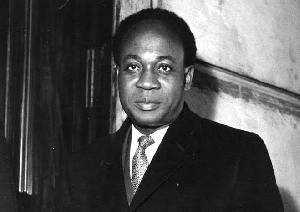 A photo of Dr Kwame Nkrumah