Ghana could earn an additional $6.56 billion from its mining sector every year if the government takes a greater role in mining activities, the Institute for Fiscal Studies (IFS) has revealed.
According to the institute, Ghana is not generating enough revenue from its mineral resources compared to countries such as Botswana, where the government plays a more active role in mining operations.
Speaking at a policy briefing in Accra, the Executive Director of IFS, Dr Said Boakye, said Ghana could have earned $8.16 billion from mining in 2025 instead of the $1.6 billion it actually collected.
Ghana ranks 18th among 25 African countries in revenue study
He explained that the difference of $6.56 billion represents the additional revenue Ghana could potentially generate by adopting a system similar to Botswana's.
Dr Boakye said Botswana earns more from mining because its government works directly with private mining companies, allowing the state to benefit from taxes, royalties and a share of company profits.
However, he noted that Ghana largely allows private companies to extract its minerals, while the government mainly relies on taxes and royalties for revenue.
He believes this arrangement limits the country's ability to maximise the benefits of its natural resources.
Dr Boakye therefore called on the government to use the upcoming 2027 Budget to introduce reforms that would enable Ghana to generate more revenue from its mining sector.
Beyond mining, the IFS also raised concerns about the amount of revenue Ghana loses through tax evasion, corruption, false declarations and tax exemptions.
He cited a disclosure by the Ghana Revenue Authority (GRA) that the country lost more than GH¢11 billion at its ports through incorrect declarations on imported goods.
The institute also revealed that Ghana ranked 18th out of 25 African countries in government revenue collection, indicating that the country generates less revenue than many of its peers.
According to the IFS, Ghana could have collected GH¢288.26 billion in total revenue and grants in 2025 if its revenue performance had matched the average of the African countries studied, instead of the GH¢224.88 billion it actually collected.
Dr Boakye warned that the government's inability to mobilise sufficient revenue affects its capacity to finance critical infrastructure and provide essential services, including roads, hospitals and schools.
He explained that when government revenue is inadequate, the country often resorts to borrowing, increasing public debt and the cost of servicing loans.
To address these challenges, the IFS is urging the government to invest directly in mining operations, strengthen partnerships with private mining companies and consider agreements that would allow the state to receive a share of mineral production.
Ghana pushes for better credit rating to reduce borrowing costs
The institute also called for stronger measures to tackle corruption in revenue collection and a review of tax exemptions granted to businesses.
Dr Boakye stressed that Ghana must find more effective ways to benefit from its natural resources and strengthen domestic revenue mobilisation to reduce reliance on borrowing and support national development.
DR/MA
BoG Developing New Stablecoin Directive to Regulate Digital Assets in Ghana– Governor
BoG Governor Gives Ghanaians Christmas Cedi Assurance | What He Promised
Business News of Monday, 9 November 2026
Source: www.ghanaweb.com
Ghana could earn extra $6.56bn annually from mining - IFS
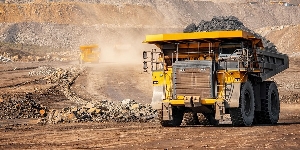 File photo of a mining site