The Ghana National Chamber of Commerce and Industry (GNCCI) National Treasurer, Michael Kabutey Caesar, has revealed that climate change is creating economic challenges for businesses, agricultural production and community livelihoods, calling for increased investment in climate-resilient projects at the local government level.
He said local authorities needed the capacity to identify green investment opportunities that could protect communities from climate risks while supporting sustainable economic activities.
BoG warns oil prices above $100 could fuel inflation
Caesar made the remarks at a two-day training workshop organised by GNCCI in partnership with Presbyterian University Ghana at the Modern City Hotel in Tamale on Saturday November 8, 2026.
The initiative seeks to create economic opportunities for women and young people through green and circular economy activities, including sustainable agriculture, agroforestry and waste management.
The workshop, held under the European Union-supported GreenGrowth Ghana Project, brought together about 40 local government officials and stakeholders from the Northern, Upper East and Upper West Regions to build their capacity to develop green and climate-resilient investments.
“Climate change is not only an environmental concern but also an economic challenge with direct implications for businesses, agricultural production and community livelihoods,” he said.
He identified waste management, composting, renewable energy, sustainable agriculture and water management as areas that could create business opportunities while addressing environmental challenges.
He also highlighted the Performance-Based Climate Resilience Grant Scheme and the United Nations Capital Development Fund's Local Climate Adaptive Living Facility as financing opportunities for local authorities.
Caesar further cited Ghana's experience under the LoCAL initiative, which has supported more than 70 climate-resilient infrastructure projects across 13 districts since 2019, creating 2,371 short-term jobs.
He also mentioned more than US$1 million disbursed through two grant cycles to support activities such as cassava processing, organic waste composting, biofertiliser production and irrigation infrastructure.
The Head of Communications at GNCCI, Peter Atsu Dotse, said stronger partnerships between local authorities and the private sector were needed to turn climate-resilient plans into sustainable economic opportunities.
He stressed the importance of connecting district priorities to businesses, investors and market opportunities.
The training forms part of the GreenGrowth Ghana Project, implemented by GNCCI in partnership with Presbyterian University Ghana and funded by the European Union.
ANAS/EB
Dr Zanetor Challenges Workers: “Turn Your Skills Into Commercial Ventures”
Business News of Sunday, 8 November 2026
Source: www.ghanaweb.com
GNCCI calls for climate-resilient investments in districts
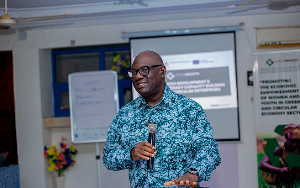 Michael Kabutey Caesar is the National Treasurer of GNCCI