The Institute for Fiscal Studies (IFS) has raised concerns over what the institute called Ghana’s weak revenue mobilization.
The IFS has revealed that the country could have generated an additional US$15.78 billion in revenue and grants in 2025 if it had matched Botswana’s revenue-to-GDP performance.
In a policy brief titled “A Reexamination of the Low Government Revenue Mobilization in Ghana”, published in October 2026, the IFS argues that Ghana is significantly underperforming compared with several Sub-Saharan African countries in generating revenue despite its considerable natural resource endowment.
The report presented by the Executive Director of IFS, Dr Said Boakye, during a press conference on November 5, 2026, indicates that Ghana's total revenue and grants accounted for only 15.7 percent of Gross Domestic Product (GDP), compared with the average of 20.1 percent among a sample of 25 Sub-Saharan African countries.
This placed Ghana 18th out of the 25 countries assessed, falling 4.4 percentage points below the regional average.
The IFS noted that countries such as Namibia, Seychelles and Botswana recorded revenue-to-GDP ratios of 31.3 percent, 30 percent and 29.5 percent respectively.
Director of Passport Yahaya Amantana Mahama interdicted - Report
According to the institute, “Ghana's poor revenue performance has serious implications for infrastructure development, public sector salaries, borrowing and the country's overall economic development.”
The policy brief estimates that Ghana collected GH¢224.88 billion in total revenue and grants in 2025, representing 15.7 percent of GDP.
However, the report argues that if Ghana had achieved the Sub-Saharan African average of 20.1 percent, it would have mobilised GH¢288.26 billion, equivalent to US$22.96 billion.
This would have been US$5.05 billion more than the US$17.91 billion actually collected.
The difference becomes even more significant when Botswana's performance is used as a benchmark.
The IFS estimates that Ghana could have generated GH¢423.06 billion, equivalent to US$33.69 billion, if its revenue-to-GDP ratio had matched Botswana's 29.5 percent.
That would have provided an additional US$15.78 billion in 2025 alone.
One of the major concerns highlighted in the report is Ghana's inability to generate substantial government revenue from its extractive sector, particularly mining.
The IFS compares Ghana's mining revenue performance with that of Botswana and concludes that the latter generates significantly more public revenue from a smaller mining sector.
Between 2019 and 2023, Ghana's average mining value added stood at US$5.03 billion but government mining revenue averaged only US$729.61 million, representing 15 percent of mining value added.
Botswana, on the other hand, recorded average mining value added of US$2.81 billion during the same period but generated average government mining revenue of US$1.72 billion, representing 60.9 percent.
The report further reveals that Ghana's mining value added reached US$13.40 billion in 2025, while government revenue from the sector stood at only US$1.60 billion.
The IFS estimates that if Ghana had achieved Botswana's average mining revenue-to-value-added ratio of 60.9 pe cent, the country could have generated US$8.16 billion from mining in 2025.
This would have provided an additional US$6.56 billion to government revenue.
The institute attributes Botswana's stronger performance partly to the government's active participation in its mining industry through partnerships with private companies.
It argues that this arrangement allows the Botswana government to benefit not only from corporate income taxes but also from dividends and royalties.
In 2022, dividends and royalties accounted for US$1.86 billion, representing 68.9 percent of Botswana's total mining revenue.
Ghana, however, largely relies on private companies operating under concession arrangements, limiting the government's ability to benefit fully from the profitability of its mineral resources, according to the report.
The IFS also identifies revenue leakages, including tax evasion, underreporting, tax avoidance and corruption, as major obstacles to revenue mobilisation.
The report cites revelations by Ghana Revenue Authority Commissioner-General Anthony Sarpong in April 2026 that the country had lost more than GH¢11 billion in revenue at its ports.
The losses were linked to incorrect declarations involving the country of origin, classification and valuation of imported goods.
Investigations reportedly uncovered collusion among key players within the import chain following the introduction of the Publican AI system at the ports.
AM
SayItLoud: Newly constructed road turns Nsakina into a nightmare whenever it rains
Business News of Friday, 6 November 2026
Source: www.ghanaweb.com
Ghana missed out on US$15.78 billion in potential revenue in 2025 – IFS
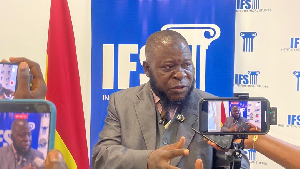 Executive Director of IFS, Dr Said Boakye