November 3, 2023, became another significant date in Ghana's efforts to deal with groups seeking to break away from the country, following the sentencing of six members of the Western Togoland Restoration Front (WTRF) and the Homeland Study Group Foundation (HSGF).
The six individuals were handed various prison sentences by an Accra High Court after being found guilty of participating in activities of the two prohibited organisations, which had advocated the creation of an independent state out of parts of Ghana.
Although the sentencing took place on November 1, 2023, the development was widely reported on November 3, making it a notable moment in Ghana's recent history.
The six convicts were Gabriel Godfred Govina, Benjamin Gbadago, Cephas Zodanu, Richard Doglo Ametepey, Cosmos Havor, also known as Togbe Adzaklo, and Vincent Ramseyer Atsu-Gadey.
They received prison terms ranging from six months to three years, with the court also imposing financial penalties totalling GH¢15,600. Collectively, their custodial sentences amounted to 13 and a half years, excluding additional prison time for failure to pay the fines.
The events that led to the convictions
The case was rooted in activities surrounding the campaign for the creation of a separate state known as Western Togoland, which proponents sought to establish by breaking away from Ghana.
The Homeland Study Group Foundation, founded by Charles Kwami Kudzordzi, popularly known as Papavi Hogbedetor, was among the groups associated with the campaign. Another organisation, the Western Togoland Restoration Front, emerged under the leadership of Michael Koku Kwabla, also known as Togbe Yesu.
The groups sought to establish a new state covering the Volta and Oti regions, as well as parts of the Eastern and Northern regions, according to the prosecution's account presented in court.
The case was closely connected to the September 25, 2020, disturbances in parts of the Volta Region, when members of the WTRF reportedly blocked roads with sand and burning tyres as part of their campaign.
The prosecution also detailed attacks on the Aveyime and Mepe police stations, where armed members reportedly overpowered officers, freed inmates, broke into police armouries and made away with weapons and ammunition.
According to the prosecution, the group stole 13 AK-47 assault rifles, two pistols, five pump-action guns and other firearms, alongside hundreds of rounds of ammunition. A police patrol vehicle was also reportedly stolen.
Three police officers were injured during the subsequent confrontation with a police team sent to restore order, while its leader, Chief Superintendent Dennis Fiakpui, was shot.
These incidents formed part of the wider security concerns surrounding the activities of the group and its campaign to establish an independent Western Togoland.
The court's decision
Justice Mary Maame Ekue Yanzuh, who presided over the case, considered the seriousness of the offences but also took into account the convicts' status as first-time offenders and their ages before imposing the sentences.
The judge was particularly critical of the group's activities, describing them as a serious threat to national security.
As reported by Graphic Online on November 3, 2023, she stated:
“I must say, with visual and documentary evidence, that the disastrous act of this organisation should send shivers down the spine of any law-abiding citizen.”
She explained that the court had opted against imposing the maximum five-year prison term because the convicts were first-time offenders.
Four other accused persons were acquitted and discharged. They were John Gbedemah, Godwin Awudza, Excel Liberty Aheto Kuegbesika and Divine Nyadzinyor.
The November 2023 convictions were another chapter in Ghana's attempts to address secessionist activities, with several other individuals linked to the Western Togoland campaign having faced prosecution in separate cases.
The case remains a significant reminder of the security challenges surrounding attempts to redraw Ghana's territorial boundaries and the legal consequences of participating in activities of organisations declared prohibited under the country's laws.
EA
General News of Tuesday, 3 November 2026
Source: www.ghanaweb.com
Today in History: Six Western Togoland secessionists jailed for 13 years
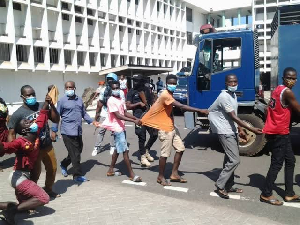 Photo of five of the Western Togoland secessionists jailed