Three Ghanaian legal luminaries made history in their lifetime by becoming Chief Justices in more than one country, setting themselves apart in Ghana’s legal history.
The three are Justice Isaac Kobina Abban, Justice Fred Kwasi Apaloo and Justice Mabel Maame Agyemang, who each served in senior judicial positions beyond Ghana’s borders.
Their appointments to lead the judiciaries of other countries highlight their contributions to the legal systems of Ghana and other African nations.
Justice Mabel Maame Agyemang
Justice Mabel Maame Agyemang, a Ghana-trained lawyer born and bred in Kumasi, has carved an extraordinary judicial career that has seen her rise to the highest judicial office in two different countries.
Justice Agyemang made history as the first female Chief Justice of The Gambia and currently serves as the Chief Justice of the Turks and Caicos Islands, a position she has held since 2020.
She was Ghana's 1st woman lawyer, and 1st woman High Court judge in the Commonwealth.
Justice Agyemang served in the judiciaries of Ghana, The Gambia and Eswatini. In August 2013, she was appointed Chief Justice of The Gambia, becoming the first woman to occupy that office.
She served until her abrupt removal in February 2014. Her international judicial journey continued in February 2020 when Nigel Dakin, Governor of the Turks and Caicos Islands, announced her appointment as Chief Justice of the Turks and Caicos Islands. She was sworn into office on March 30, 2020, and officially assumed duty on April 1, 2020.
Justice Fred Kwasi Apaloo
Another person on the list is Justice Fred Kwasi Apaloo, one of Ghana's most respected judges. He served as Chief Justice of both Ghana and Kenya, and made history as the only judge to have served on Ghana's Supreme Court under three different republics.
In 1964, he presided over the treason trial involving five people accused of plotting against the late former President Kwame Nkrumah's government. Among the accused were Information Minister Tawia Adamafio, Foreign Affairs Minister Ebenezer Ako-Adjei, and Convention People's Party Secretary Hugh Horatio Cofie Crabbe.
His decision to acquit the accused earned him a reputation for judicial independence despite creating tension with the government. Apaloo was then promoted to the Court of Appeal in 1966 and appointed to the Supreme Court of Ghana in 1971.
In 1977, during the rule of the Supreme Military Council, he became Ghana's sixth Chief Justice since independence. He served as Chief Justice until his retirement in 1986.
Following the return to constitutional rule in 1979, the People's National Party government sought to replace him by insisting that he undergo vetting for the office he already occupied. The matter ended up at the Supreme Court after a citizen, Amoako Tuffuor, challenged the move.
The court ruled that Apaloo automatically became Chief Justice under the 1979 Constitution when it came into force, allowing him to remain in office. He continued serving after the Provisional National Defence Council, led by Jerry John Rawlings, took power on December 31, 1981.
The military government also attempted to remove him in 1983, but was unsuccessful because of his constitutional position. After retiring at the age of 65 in 1986, Apaloo joined the Kenyan judiciary.
He first served as a High Court judge before rising to the Court of Appeal. He later worked with the World Bank Administrative Tribunal. In March 1993, Kenya appointed him as its ninth Chief Justice after a vacancy arose with no obvious local candidate to fill the position.
During his tenure in Kenya, Apaloo was known for his opposition to the death penalty. He served as Chief Justice until 1995. Apaloo sadly passed on at the age of 79 in April 2000, leaving behind a wife and five children.
Justice Isaac Kobina Abban
Justice Isaac Kobina Abban served as Ghana’s Chief Justice from 1995 to 2001, becoming the ninth person to occupy the position since the country gained independence.
He was called to the English Bar on June 24, 1958, and returned to Ghana in 1959, where he began private legal practice. In May 1970, he was appointed a High Court judge.
While serving as a High Court judge, he was appointed Electoral Commissioner. He later moved to Seychelles, where he served as Chief Justice from 1990 to 1993.
Upon his return to Ghana, he rejoined the Judicial Service and was appointed to the Supreme Court. On February 22, 1995, then-President Jerry John Rawlings appointed him Chief Justice.
Justice Abban passed away in 2001 at the age of 67.
General News of Saturday, 31 October 2026
Source: www.ghanaweb.com
How 3 Ghanaian judges made history as Chief Justices in more than one country
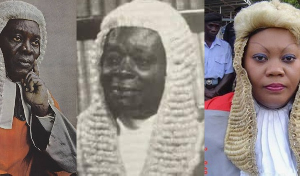 (From L-R) Justice Isaac Kobina Abban, Justice Fred Kwasi Apaloo and Justice Mabel Maame Agyemang