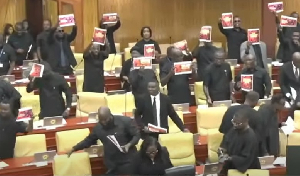
The Minority in Parliament has rejected the 9 per cent salary increase agreed for public sector workers in 2027, describing the deal as an insult to workers whose incomes are struggling to keep pace with rising utility bills, transport fares, rent and other household expenses.
The Minority Caucus on Employment, Labour Relations and Pensions is also questioning the role of Organised Labour in the negotiations, accusing union leaders of accepting an inadequate deal despite earlier assurances that they would push for a more substantial increase in workers' base pay.
In a statement signed by its Ranking Member, Mavis Nkansah Boadu, and issued on October 30, 2026, the caucus said the newly signed Multi-Year Public Service Remuneration Agreement, finalised on October 28, had failed to reflect the economic difficulties confronting ordinary Ghanaian workers.
Under the agreement, public sector workers are expected to receive a total remuneration increase of 9 per cent in 2027, comprising an 8 per cent base pay adjustment and a 1 per cent increase in conditions of service. The proposed adjustment for 2028 is 10 per cent.
The Minority described the arrangement as a continuation of what it considers an unfair wage policy, pointing to the 10 per cent increase in 2025 and 9 per cent in 2026.
It argued that successive salary adjustments have failed to adequately protect workers' purchasing power, particularly as the cost of essential services continues to rise.
"The Ghanaian worker deserves dignity, economic justice, and a fair share of national prosperity," the caucus declared, insisting that government cannot demand wage restraint while households face repeated increases in the cost of basic necessities.
Minority questions Organised Labour's role
Beyond the salary figures, the caucus has turned its criticism towards Organised Labour, questioning whether union leaders adequately represented the interests of their members during the negotiations.
It recalled that labour leaders had reportedly assured workers, barely two weeks before the agreement was signed, that they would push for a significant increase in the 2027 base pay.
However, the Minority said the eventual agreement had fallen short of those expectations, with workers now committed to a two-year remuneration framework.
The caucus also drew parallels with the 2026 salary negotiations, when Organised Labour accepted a 9 per cent increase despite some union leaders describing the figure as "woefully inadequate".
According to the Minority, the latest agreement has deepened frustration among rank-and-file union members, some of whom are questioning whether their leaders prioritised workers' welfare or industrial peace with government.
"The feedback reaching the Minority Caucus from rank-and-file members of the unions across the country is one of deep disappointment, not only with Government but with those who signed on their behalf," the statement said.
It has consequently urged union members to demand explanations from their leadership on the proposals presented during negotiations, the concessions made and the reasons behind accepting the two-year deal.
The caucus further argued that the agreement fails to adequately account for the financial pressures facing households, particularly the rising cost of electricity, water, accommodation, transportation and cooking gas.
It cited the Public Utilities Regulatory Commission's (PURC) tariff adjustments as evidence of the pressure on consumers.
Effective January 1, 2026, electricity tariffs increased by an average of 9.86 per cent, while water tariffs went up by 15.92 per cent under the Commission's multi-year tariff review. Both utilities remain subject to periodic adjustments under the regulatory framework.
The Minority also pointed to the 8 per cent increase in public transport fares introduced on September 26, 2026, arguing that such adjustments further reduce the value of workers' take-home pay.
On housing, it raised concerns about increasing rents and reports of landlords demanding one or two years' rent in advance, despite the six-month rent advance limit under Ghana's Rent Act, 1963 (Act 220).
It also cited increases in mobile data charges and the cost of cooking gas, arguing that workers are being forced to spend a growing proportion of their earnings on basic necessities.
The caucus described the situation as an unfair economic burden, insisting that government cannot expect public servants to accept modest salary adjustments while essential household expenses continue to rise.
Minority demands reopening of negotiations
The Minority is now calling for an immediate review of the remuneration agreement and has urged government to reconvene the Public Services Joint Standing Negotiating Committee (PSJSNC).
It wants future salary negotiations to take into consideration the actual cost of living, including increases in utility tariffs and other essential commodities.
The caucus also wants government to stop using the planned transition from the Fair Wages and Salaries Commission (FWSC) to the Independent Public Emoluments Commission (IPEC) as justification for restricting workers' remuneration.
It has further demanded that Organised Labour publish the proposals it presented during negotiations and explain to its members why it accepted the two-year agreement.
However, the government's position, as communicated after the signing, is that the arrangement provides predictability during the transition to IPEC and balances workers' welfare with fiscal sustainability.
The agreement also contains a provision for the negotiating committee to reconvene and review the 2028 base pay if December 2027 year-on-year inflation exceeds 16 per cent. The current inflation figure cited in the agreement is 5.2 per cent.
The TUC Secretary-General, Joshua Ansah, has acknowledged that the 2027 adjustment may not fully address workers' financial difficulties, although he described the agreement as progress in protecting their purchasing power. Ghana News Agency
Despite these provisions, the Minority insists that the agreement does not go far enough to protect public sector employees.
"The Ghanaian worker deserves dignity, economic justice, and a fair share of national prosperity," the statement concluded.
EA
General News of Friday, 30 October 2026
Source: www.ghanaweb.com
Ghanaian workers are being shortchanged - Minority tears into 9% salary deal
 Minority in Parliament