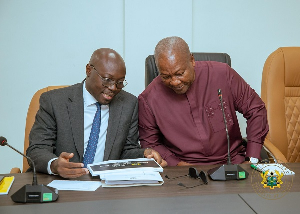
Renowned economist and Member of the Presidential Advisory Group on the Economy (PAGE), Kwame Pianim, has named Vice-President Professor Naana Jane Opoku-Agyemang his favourite economist.
Speaking at the launch of the Ghana National Association of Teachers’ (GNAT) "Thank You Teacher” National Raffle in Accra on October 28, 2026, he expressed admiration for Prof Opoku-Agyemang's empathy for the poor and her insistence that economic policies must affect ordinary Ghanaians.
Ghana's 'New Economy' Policy: What it is about and when it will be introduced
Pianim said the vice president often challenges members of PAGE to consider how economic decisions affect vulnerable people.
According to him, in discussions on macroeconomics, she raises questions about the impact of policies on single mothers in rural communities, women entrepreneurs and young people who earn a living by selling goods in the heat.
“One thing I like about her, she is my favourite economist. Why do I say that? Whenever we are talking macroeconomics at the Presidential Advisory Group on the Economy, she always says, how does it help the single mother in the village, the women entrepreneur?” he said.
Pianim further noted that her questions bring the focus back to the well-being of ordinary Ghanaians, rather than economic figures alone.
“She makes you realise that macroeconomics, everything boils down to the state, the status, the well-being of the average Ghanaian,” he added.
Pianim said Ghana could make significant progress if its political leaders showed similar concern for people struggling to make ends meet.
“If the political elite of Ghana were to have 10% her empathy for the poor, this country in 10 years’ time will be better than Singapore,” he added.
JKB/VPO
Ghana Airports at 20: How Two Decades Have Transformed Air Travel
General News of Wednesday, 28 October 2026
Source: www.ghanaweb.com
Why Kwame Pianim calls veep his favourite 'economist'
 Kwame Pianim commends Prof Opoku-Agyemang's approach to economic policy