Ghana has become the first country to sign the United Nations Convention on Negotiable Cargo Documents, joining 25 other countries in a landmark agreement aimed at making it easier for businesses to access trade finance, sell goods while they are in transit and conduct cross-border trade using digital documents.
Accra Convention seeks to help businesses use goods in transit to secure financing, cut documentation barriers and accelerate digital trade.
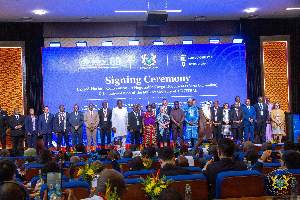
The signing ceremony took place in Accra on Monday, October 26, 2026, marking the opening of the agreement, popularly known as the Accra Convention, for signature. The treaty establishes a common legal framework for negotiable cargo documents covering goods transported by road, rail, air and sea. The United Nations Treaty Collection confirms that 26 countries signed the Convention on the opening day.
Speaking on behalf of President John Dramani Mahama, the Minister for Trade, Agribusiness and Industry, Elizabeth Ofosu-Adjare, said the agreement could address longstanding barriers that have made it difficult for businesses, particularly small and medium-sized enterprises (SMEs), to obtain financing using goods being transported as collateral.
She explained that while maritime trade has long benefited from negotiable shipping documents that allow goods to be sold during transit and used to secure bank financing, similar arrangements have not been widely available for goods transported by road, rail and air.
The new framework seeks to close that gap by allowing negotiable cargo documents to represent goods in transit and establish legally recognised rights over them. This could give businesses greater flexibility to trade goods before they arrive at their destinations and improve their ability to obtain financing.
The scale of the challenge is significant for Africa. Estimates cited at the ceremony put the share of the continent's freight transported by road at between 80 and 90 per cent. Intra-African trade accounted for just 14.4 per cent of the continent's total trade in 2024, while Africa's trade finance gap was estimated at between US$74 billion and US$92 billion that year.
These figures point to the need for stronger trade infrastructure, more efficient cross-border documentation and better access to finance, particularly for businesses seeking to expand beyond their domestic markets.
Under the Convention, negotiable cargo documents may be issued in paper or electronic form, with electronic versions receiving the same legal recognition under the framework. The rules also seek to protect parties who rely on the documents in good faith, reduce legal uncertainty and support the movement of goods across different transport systems.
For businesses, the potential benefits include fewer documentation-related obstacles, greater opportunities to use goods in transit to support financing arrangements and more efficient transactions across international supply chains. The agreement also provides for a single negotiable cargo document to cover an entire journey involving different modes of transport, potentially simplifying trade procedures and customs clearance.
Ofosu-Adjare reaffirmed Ghana's commitment to pursuing ratification of the treaty and reviewing relevant domestic laws to support its implementation. The areas under consideration include transport, the sale of goods, evidence, electronic transactions and secured lending.
She also announced plans for a pilot initiative involving the Ghana Shippers' Authority, the Ghana Ports and Harbours Authority, the Customs Division of the Ghana Revenue Authority and banks. The initiative is expected to help stakeholders explore how negotiable cargo documents can work in practice within Ghana's trade and logistics sector.
The Secretary of the United Nations Commission on International Trade Law (UNCITRAL), Anna Joubin-Bret, commended Ghana for hosting the ceremony and acknowledged the cooperation between the Ghanaian government and the UNCITRAL Secretariat in preparing for the treaty's opening for signature.
She said the Convention could reduce legal uncertainty, facilitate trade finance, strengthen supply chains and support digital trade as African countries deepen economic integration under the African Continental Free Trade Area (AfCFTA).
Joubin-Bret described the signing ceremony as an important first step towards putting the new international legal framework into practice and called on countries to support its wider adoption and implementation.
Delegations from participating countries also had the opportunity to make statements on the agreement and its implications for international trade and transport.
The United Nations General Assembly adopted the Convention on December 15, 2025, under Resolution 80/162. It was designed to extend the benefits of negotiable cargo documents beyond maritime transport and provide a harmonised legal basis for their use across different transport modes.
However, the signing does not mean the treaty is already in force. Under its terms, the Convention will enter into force 180 days after the deposit of the tenth instrument of ratification, acceptance, approval or accession. Countries must therefore complete the relevant domestic legal procedures before the framework becomes operational for them.
The 26 signatories are Ghana, Sierra Leone, Burkina Faso, Cabo Verde, China, Comoros, Côte d'Ivoire, Cuba, the Democratic Republic of the Congo, Djibouti, Dominica, the Dominican Republic, Gabon, The Gambia, Guinea, Guinea-Bissau, Mauritania, Nicaragua, Nigeria, Pakistan, Rwanda, Saudi Arabia, South Sudan, Togo, Tanzania and Venezuela.
The agreement places Accra at the centre of a new international effort to modernise cargo documentation and make trade finance more accessible. Its eventual impact, however, will depend on ratification, domestic legal reforms and effective implementation by governments, banks, transport operators and other industry players.
EA
Business News of Tuesday, 27 October 2026
Source: www.ghanaweb.com
Ghana leads 26 countries to sign UN Trade Convention to boost trade finance
 Ghana leads 26 countries to sign UN Trade Convention to boost trade finance