Ghana will face another transition in judicial leadership when Chief Justice Paul Baffoe-Bonnie reaches the mandatory retirement age of 70 on December 26, 2026, just over a year after taking office.
Sworn in on November 17, 2025, Justice Baffoe-Bonnie’s approaching retirement places an important decision before President John Dramani Mahama: who should lead the Judiciary into its next chapter? His date of birth and assumption of office confirm the relatively short tenure, while the Chief Justice himself has publicly acknowledged that his term ends in December.
The question brings together several considerations: experience on the bench, institutional leadership, legal scholarship and the ability to strengthen public confidence in the courts.
This DL News feature examines six Supreme Court justices whose professional backgrounds offer different perspectives on that choice: Gabriel Pwamang, Avril Lovelace-Johnson, Emmanuel Yonny Kulendi, Samuel Kwame Adibu-Asiedu, Senyo Dzamefe and Dennis Dominic Adjei. Their inclusion is an assessment of their records, rather than an official shortlist.

Seniority carries weight, but does not decide
The Constitution places the appointment in the hands of the President, acting in consultation with the Council of State and with Parliament’s approval.
Article 144(1) provides:
“The Chief Justice shall be appointed by the President acting in consultation with the Council of State and with the approval of Parliament.”
The provision does not require the President to appoint the longest-serving Supreme Court justice. Consequently, a judge’s seniority may be relevant to the discussion without creating an entitlement to the office.
There is, however, an important distinction between appointment as Chief Justice and temporarily performing the functions of that office. Under Article 144(6), when the office becomes vacant, or the Chief Justice is unable to perform its functions, the most senior Supreme Court justice performs those functions until the appropriate constitutional arrangements are completed. Acting in that capacity does not automatically confer the substantive appointment.
Gabriel Pwamang: the seniority consideration
Justice Gabriel Pwamang occupies the position immediately after the Chief Justice on the Judicial Service’s published Supreme Court list. Appointed in June 2015, he has more than a decade of experience on the apex court.
Before joining the bench, he was a private legal practitioner and managing partner of Pwamang and Associates. His professional work included land and natural resources law, human rights and criminal justice. He also served on the Constitution Review Commission from 2010 to 2011.
His record combines extensive Supreme Court service with experience in constitutional review and private practice. For an appointment centred on institutional continuity, that background presents a clear consideration.
Avril Lovelace-Johnson: experience across the court system
Justice Avril Lovelace-Johnson follows Justice Pwamang on the Judicial Service’s published list and is its highest-listed female Supreme Court justice. She joined the apex court in December 2019 after serving at the High Court and Court of Appeal.
Her judicial career began in 1990 and includes service as a magistrate and Circuit Court judge. She subsequently became a High Court justice in 2002 and a Court of Appeal justice in 2012. Her experience also extends beyond Ghana, including a judicial assignment in The Gambia.
She currently represents Supreme Court justices on the Judicial Council, adding an institutional governance role to her adjudicative experience.
Her progression through several levels of the courts offers a broad understanding of the practical demands facing judges, court staff and litigants.
Emmanuel Yonny Kulendi: the private-practice perspective
Justice Emmanuel Yonny Kulendi entered the Supreme Court directly from private practice in 2020. Before his appointment, he founded and led Kulendi @ Law, bringing experience in commercial and constitutional legal practice to the bench.
Called to the Bar in 1994, he holds a law degree from the University of Ghana and a master’s degree in International Security and Civil-Military Relations from the Naval Postgraduate School in the United States.
His professional route differs from that of judges who advanced through the lower courts. It offers the perspective of a former practising lawyer who managed a firm before taking on the responsibilities of the apex court.
Samuel Kwame Adibu-Asiedu: progression through the ranks Justice Samuel Kwame Adibu-Asiedu’s career reflects a steady rise through Ghana’s judicial hierarchy.
He joined the bench in 1996 and served as a magistrate, Circuit Court judge, High Court justice and Court of Appeal justice before reaching the Supreme Court. His professional background also includes teaching at legal and academic institutions.
He was sworn into the Supreme Court on December 28, 2022, following his promotion from the Court of Appeal.
Although his Supreme Court tenure is shorter than that of some colleagues considered here, his judicial service spans approximately three decades. That experience offers familiarity with the operational realities of courts at several levels.
Senyo Dzamefe: judicial administration and reform
Justice Senyo Dzamefe joined the Supreme Court in July 2025 after a lengthy career that included service in the public tribunal system, the High Court and the Court of Appeal. Called to the Bar in 1984, he became a High Court justice in 2000 and joined the Court of Appeal in 2010.
His leadership experience includes serving as President of the Association of Magistrates and Judges of Ghana and participating in judicial governance and disciplinary structures.
At his parliamentary vetting in June 2025, he advocated measures to improve court efficiency, including expanded virtual hearings, better working conditions for judicial staff and technology to reduce reliance on handwritten proceedings.
Those proposals provide a public indication of his thinking on judicial administration, a central responsibility of the Chief Justice.
Dennis Dominic Adjei: scholarship and international judicial service
Justice Dennis Dominic Adjei’s record combines domestic judicial work, international adjudication and legal education.
He served on the Court of Appeal from July 2010 until his elevation to the Supreme Court in July 2025. He was also elected to the African Court on Human and Peoples’ Rights in 2022 for a six-year term and has served on the International Criminal Court’s Advisory Committee on nominations of judges.
Within Ghana, he led the Judicial Training Institute from 2014 to 2022 and served as Dean of GIMPA’s Faculty of Law from 2019 to 2020. His legal publications cover subjects including statutory interpretation, criminal procedure, constitutional law, land law and alternative dispute resolution.
His background offers a combination of judicial management, professional training and comparative legal experience that could inform the leadership of the Judiciary.
A choice beyond longest service
The six records illustrate the range of experience available within the Supreme Court. They do not exhaust the possible field, and the Constitution does not restrict the appointment to these individuals.
The eventual choice will carry responsibilities extending beyond presiding over cases. Under Article 125(4), the Chief Justice heads the Judiciary and is responsible for its administration and supervision.
The succession question therefore concerns both legal ability and institutional leadership: who can support judicial independence, improve the running of the courts and make justice more accessible?
Seniority, scholarship and administrative experience may each inform that decision. The answer will ultimately emerge through the President’s nomination, consultation with the Council of State and parliamentary approval.
General News of Monday, 26 October 2026
Source: Dennis Law News
Who succeeds Chief Justice Baffoe-Bonnie?
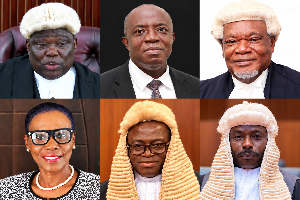 Ghana will face another transition in judicial leadership when CJ Baffoe-Bonnie retires in December