The leader of the Ghana Environmental Advocacy Group, Elizabeth Vaah, has criticised Ghana Gold Board (GoldBod) chief executive officer Sammy Gyamfi’s position on formalising unlicensed artisanal and small-scale miners, questioning how the government intends to prevent land encroachment and environmental destruction.
Vaah was reacting to a video of Gyamfi defending the formalisation of eligible unlicensed small-scale mining operators, arguing that bringing them into a regulated system would be more effective than pursuing them with security personnel.
She questioned whether the proposed approach could prevent miners from operating on burial grounds, taking over private farms or digging in other locations where mining could threaten communities and livelihoods.
“We were made to think you are very smart. This your position on ASM is lazy and stupid,” Vaah said in a Facebook post.
“Are we saying they can mine burial grounds and a myriad other places in between? They can even hijack somebody’s farm and mine it?” she asked.
Vaah also challenged the assumption that mining outside designated restricted areas would necessarily protect the environment, pointing to the potential impact of surface mining on rivers and land.
“BTW, where has surface mining been done in Ghana without affecting rivers and destroying the land?” she said.
She proposed that the government use the Geological Survey Authority to identify and map areas with commercially viable gold deposits before opening them to mining under clearly defined conditions.
According to Vaah, such areas should be formally demarcated, with safeguards to ensure that mining is properly supervised and the proceeds are shared equitably.
“The sensible thing to do is to use the Geological Services department to identify and mark places where there is gold in commercial quantity, then put clear measures in place to demarcate, supervise and ensure that mining is done right and proceeds are equitably shared,” she said.
She argued that allowing miners to operate without adequate controls over where and how they extract minerals would expose communities and the environment to further harm.
“Giving people free range to go and dig and destroy anywhere they want is lazy and a sign of stupidity,” Vaah added.
Defence
Gyamfi has maintained that three categories of unlicensed artisanal and small-scale mining operations cannot be tolerated or reformed: mining that affects water bodies, mining in forest reserves, and mining in dangerous or inappropriate locations within communities, including roadsides, school lands and residential areas.
He said unlicensed operations outside those prohibited areas could qualify for formalisation under the government’s Responsible Cooperative Mining and Skills Development Programme (rCOMSDEP), provided they meet the relevant requirements.
The GoldBod chief executive has argued that the initiative would help transform eligible unlicensed miners into licensed and responsible operators through legal documentation, permits, certification and training.
His comments have triggered public debate over whether formalising eligible miners can effectively address illegal mining, commonly known as galamsey, while protecting water bodies, forests, farms and community lands.
The Ghana National Association of Small Scale Miners has defended Gyamfi, arguing that a viral video of his remarks was circulated without the full context and that he was referring to the regularisation of eligible operators rather than endorsing illegal mining.
GoldBod has also announced plans to roll out an Artisanal and Small-Scale Mining Formalisation and Financing Support Programme in 2027, in collaboration with the Ministry of Lands and Natural Resources, the University of Mines and Technology and South Africa’s Rand Refinery.
The programme is intended to improve productivity, create jobs and reduce the environmental impact of small-scale mining.
Vaah’s intervention adds to the debate over the safeguards needed to ensure that efforts to bring unlicensed miners into the formal economy do not undermine land rights, environmental protection and the enforcement of mining regulations.
General News of Sunday, 25 October 2026
Source: asaaseradio.com
'Lazy' - Environmental advocate blasts GoldBod's plan to formalise eligible galamseyers
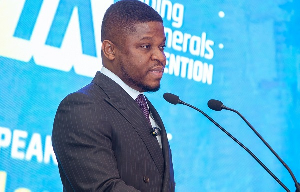 GoldBod CEO, Sammy Gyamfi


Entertainment