Ghana has launched a United Nations-backed initiative to promote sustainable construction materials and affordable housing as part of efforts to address the country's estimated 1.83 million housing deficit while reducing greenhouse gas emissions.
The Transforming Ghana's Built Environment Through Sustainable Materials Demonstration Project was launched in Accra through a partnership between the Ministry of Works, Housing and Water Resources and United Nations agencies, including the United Nations Environment Programme (UNEP), the United Nations Office for Project Services (UNOPS) and UN-Habitat.
The project is funded by the German Federal Ministry for Economic Cooperation and Development (BMZ) and seeks to promote locally available, low-carbon building materials, strengthen local construction value chains and support the delivery of affordable, climate-resilient homes across the country.
Speaking at the launch and stakeholder validation workshop on October 22, 2026, the Minister of Works, Housing and Water Resources, Ahmed Ibrahim, said Ghana's housing deficit presented both a significant development challenge and an opportunity to adopt more environmentally sustainable construction practices.
He stressed that decisions on building materials made today would have long-term consequences for the country's carbon emissions, noting that buildings could last for 100 years or more.
“With much of Africa's future building stock yet to be constructed, choosing low-carbon materials is essential to reducing emissions for generations to come,” he said.
Ibrahim called for a shift away from conventional, energy-intensive construction methods, arguing that Ghana needed innovative approaches to meet its housing needs without increasing its environmental footprint.
“We cannot continue to use the same approach of yesterday to achieve the results we need tomorrow,” he stated.
The initiative is expected to encourage the use of locally available and environmentally friendly materials, including bio-based products and alternatives to conventional cement and steel, where technically appropriate.
According to Ibrahim, the project aims to establish an enabling framework for responsible sourcing of building materials and the development of sustainable construction tools.
It also promotes the “Avoid, Shift and Improve” approach in the building sector, which seeks to reduce unnecessary construction, encourage more sustainable building practices and improve the environmental performance of materials and construction processes.
The minister said the initiative aligned with Ghana's broader climate objectives and international commitments, including the Paris Agreement and the United Nations' 2030 Agenda for Sustainable Development.
He added that UNEP had supported Ghana's efforts to promote sustainable construction through policy advice, technical guidance, pilot studies and capacity-building initiatives, building on the country's climate action roadmap for buildings and construction.
The Head of Office of the UNOPS Ghana Country Office and infrastructure specialist, Linda Agbesi, said the project reflected Ghana's commitment to addressing its housing needs while responding to climate change.
She explained that the initiative would promote locally available, low-carbon construction materials and apply a whole-life-cycle approach to housing development.
According to her, the approach would consider the environmental and economic implications of buildings throughout their life cycle, rather than focusing solely on construction costs.
Agbesi said the project demonstrated that sustainable construction could be environmentally responsible, economically viable and scalable.
She also highlighted a techno-economic feasibility study on low-carbon model houses designed to support the Ministry's District Housing Programme in line with Legislative Instrument (LI) 2411.
The study examines the technical and financial viability of the proposed housing models, their compliance with regulatory requirements and their potential for expansion.
She said the findings would provide a basis for developing replicable low-carbon housing models and informing future public investment decisions.
Meanwhile, Thomas Kankam-Adjei, National Projects Coordinator and Country Advisor for UNEP, underscored the importance of accelerating Ghana's transition towards low-carbon and circular construction.
He noted that the built environment was central to achieving international climate and sustainable development targets, adding that choices made in the construction sector today would influence emissions for decades.
The project also involves technical and analytical support to advance circularity in construction, alongside research, stakeholder engagement and pilot initiatives.
The launch also served as a stakeholder validation workshop, bringing together relevant actors to review research findings and technical assessments on sustainable construction materials.
Obuasi SHTS Saga: Zakaria Abdulai speaks after police caution, bail
Technical sessions led by Blue Alliance featured discussions on techno-economic feasibility studies, financial analyses and a draft compendium of locally available low-carbon building materials.
Stakeholders were expected to assess the findings and provide feedback to strengthen the evidence base for adopting sustainable materials in Ghana's construction sector.
AM
Inside Ghana’s Abandoned Engineering Powerhouse: What Went Wrong?
Business News of Friday, 23 October 2026
Source: www.ghanaweb.com
Ghana launches low-carbon building initiative to tackle 1.83 million housing deficit
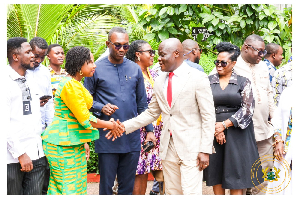 The minister in the midst of other stakeholders








Opinions