The Minister for Lands and Natural Resources, Emmanuel Armah-Kofi Buah, says Ghana is shifting from the worst phase of forest destruction caused by illegal mining to efforts aimed at restoring degraded lands, following what he describes as significant progress in the fight against galamsey.
He said illegal mining had destroyed forest areas equivalent to more than 12,500 football fields, leaving the country with a costly environmental restoration challenge.
“We destroyed 12,500 football fields, and now we have to go and look for billions and billions of dollars to reclaim our destroyed lands,” Mr Buah said.
The minister made the remarks at the launch of the Nzema East Responsible Cooperative Mining Society in Axim in the Western Region, an initiative designed to organise small-scale mining, promote responsible mineral extraction and create opportunities for young people.
Describing the scale of environmental destruction inherited by the current administration, Mr Buah said some forest reserves had become so dangerous and difficult to access that Forestry Commission officials could not enter them.
“In fact, it was so bad that some of the forest areas had been overtaken not only by attacks by foreigners, but the Forestry Commission couldn't enter. We called them no-go zones,” he said.
According to the minister, the government began its anti-galamsey campaign from a severely damaged environmental situation, which must be considered when assessing its performance.
“So we began from a bottom hole. That's the fight and how we began, and that's where His Excellency the President began,” he stated.
He urged Ghanaians to assess the government's interventions against the scale of the problem it faced when it assumed office, arguing that meaningful progress could only be judged by considering the extent of the damage and the measures introduced to address it.
“Today, as we discuss responsible mining, I want everybody in Ghana who has been talking a lot about what steps we've taken to look at the depth in which we have come, how deep we were sunk, and then think about the steps we've taken in the last two years. That is where you are able to make a fair assessment of the progress we are making,” he said.
‘We have stopped the bleeding’
Mr Buah expressed confidence that the government's interventions were beginning to yield results, declaring that the situation in the country's forest reserves had improved.
“Today, I'm proud to tell you that we have stopped the bleeding,” he said.
He added that the government's next major task was to rehabilitate areas already damaged by illegal mining, pointing to the Tree for Life Reforestation Initiative as a key component of the restoration drive.
“All the forests are no longer red zones; they are green zones because we have cleared it. And now what we have to worry about is all those that have been destroyed, and how we now have to plant trees. That is why we've launched what we call the Tree for Life initiative,” he stated.
The Tree for Life initiative is a national programme intended to restore degraded landscapes, improve forest cover and address environmental damage caused by illegal mining and other activities.
Official government figures indicate that the initiative recorded the planting of more than 31 million tree seedlings in 2025, with approximately 23,600 hectares of degraded landscapes restored. The government has set a target of planting another 30 million seedlings in 2026. However, the long-term success of the programme will depend on the survival of the seedlings, sustained maintenance and the effective rehabilitation of damaged ecosystems.
Mr Buah called for collective responsibility in protecting the country's natural resources, stressing that environmental preservation must extend beyond the tenure of any government.
“When we are dead and gone, we have the responsibility to make sure that we leave our forest and our water bodies in a better condition for those who come after us,” he said.
Government outlines strategy to fight galamsey
The minister also credited President John Dramani Mahama with providing political leadership for the fight against illegal mining and the protection of Ghana's forests and mineral resources.
He said the government's approach was anchored on five pillars, with stakeholder engagement forming a key part of the strategy.
According to him, the fight cannot be won through military and security operations alone but requires the active participation of traditional authorities, mining communities, young people and the wider public.
“It's not about anything, it's not about even the soldiers, it's about the heart and mind of every Ghanaian,” Mr Buah said, explaining the importance of dialogue and public participation.
The broader strategy includes stronger enforcement of mining laws, reforms to the licensing regime, stakeholder engagement and education, reclamation of degraded lands, and the promotion of alternative livelihoods for mining communities.
The government has repeatedly maintained that tackling illegal mining requires a combination of law enforcement, regulatory reforms and sustainable economic opportunities for communities that depend on mining.
Nzema East cooperative to promote responsible mining
Meanwhile, Herbert Kuah Dickson stressed the importance of the Nzema East Responsible Cooperative Mining Society in empowering young people and bringing greater order to small-scale mining in the municipality.
He called on traditional leaders, locally known as Nananom, and other stakeholders to support President Mahama's vision for responsible mining.
The cooperative initiative is intended to encourage more organised mining practices while improving compliance with regulations and reducing the environmental damage associated with irresponsible mineral extraction.
The initiative comes amid continuing national concerns over galamsey, particularly its impact on forest reserves, farmlands, and water bodies.
For Ghana, the challenge remains twofold: preventing further environmental destruction while restoring the landscapes and water systems already damaged by illegal mining.
Although the government says it has made progress in containing the threat, the durability of those gains will depend on sustained enforcement, accountable mining practices and measurable improvements in the condition of affected forests and water bodies.
EA
General News of Friday, 16 October 2026
Source: www.ghanaweb.com
‘We have stopped the bleeding’ – Lands Minister on Ghana’s galamsey fight
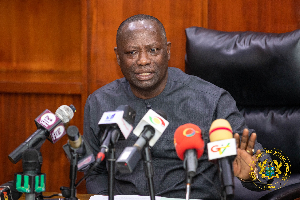 Minister for Lands and Natural Resources, Emmanuel Armah-Kofi Buah