The entrance of Kinbu Senior High Technical School in Accra has come under scrutiny after a social media commentator, Elikem Kofi Ablorde, raised concerns about hawkers occupying the area and alleged illegal foreign currency exchange, questioning why the Accra Metropolitan Assembly (AMA) has not addressed the situation.
In a Facebook post, Ablorde described the school entrance as having been turned into a market, with traders and buyers occupying the space. He questioned the Assembly’s apparent inaction, pointing to its proximity to the school.
“From here to the Accra Metropolitan Assembly should be less than a five-minute walk, yet the Assembly wouldn’t do anything,” he wrote.
The commentator also alleged that some people were changing foreign currencies illegally at the location, warning that the situation could raise security concerns.
“If this doesn't raise any security concerns, then I don't know what will,” he added, calling for public officials to focus on taking appropriate action rather than merely holding positions of authority.
Ablorde’s claims have not been independently verified, and the specific nature of the alleged currency exchange activities remains unclear. The AMA’s response to the concerns was also not included in the original post.
Hawking and the battle for pedestrian space in Accra
The concerns raised over the entrance of Kinbu Senior High Technical School reflect a broader challenge facing Accra, where street trading frequently competes with pedestrians for limited public space.
In parts of the capital, hawkers display their goods on pavements, road shoulders, and other spaces intended to provide safe passage for pedestrians. In busy commercial areas, traders and their customers can occupy much of the available walkway, forcing people to step onto roads and navigate moving traffic.
The consequences extend beyond inconvenience. Obstructed walkways can expose pedestrians to road crashes, restrict access for people with disabilities and older persons, and create difficulties for schoolchildren and other commuters moving through crowded areas.
Where trading takes place close to school entrances, the need to maintain clear access becomes particularly important for students, parents, school staff, and emergency responders.
However, the challenge cannot be addressed by enforcement alone. Street trading provides a livelihood for many people, making designated trading spaces, consistent regulation, and engagement with traders important parts of any lasting solution.
AMA’s decongestion challenge
The Accra Metropolitan Assembly has previously undertaken decongestion exercises to remove unauthorized trading structures and restore pedestrian access in parts of the capital.
Such operations are intended to ease congestion, improve sanitation, and ensure that public spaces remain accessible. Yet the continued occupation of some walkways by traders has kept the issue in public debate.
Ablorde’s post raises questions about whether existing measures are being consistently enforced around Kinbu Senior High Technical School and who is responsible for monitoring the area.
The allegations concerning foreign currency exchange also warrant verification by the relevant authorities. The mere presence of people changing money does not, by itself, establish that an offense has occurred; the nature of the transactions and whether the operators are authorized would need to be established.
The AMA would need to clarify whether it is aware of the reported situation, what measures have been taken, and whether further enforcement is planned.
Ultimately, the issue at Kinbu Senior High Technical School raises a wider question about the management of Accra’s public spaces: how can the city protect pedestrian access and public safety while ensuring that street traders have practical and lawful opportunities to earn a living?
For residents and commuters, the immediate concern is straightforward: school entrances and pedestrian walkways should remain accessible, safe, and free from obstructions.
The situation described by Ablorde now puts the spotlight on the relevant authorities to establish the facts and explain what action, if any, will be taken.
General News of Tuesday, 13 October 2026
Source: www.ghanaweb.com
Kinbu SHS entrance turns market as social commentator questions AMA
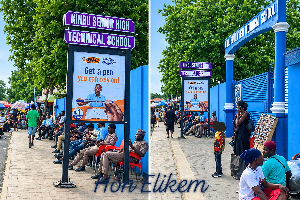 Kinbu SHS entrance