Ghana has launched three new legal instruments aimed at strengthening social protection for vulnerable citizens and increasing women’s representation in leadership and decision-making, with Vice President Professor Naana Jane Opoku-Agyemang warning that their success will depend on effective implementation.
The instruments—the Social Protection Act, 2025 (Act 1148), the Social Protection Regulations, 2026 (L.I. 2521), and the Affirmative Action (Gender Equity) Regulations, 2026 (L.I. 2522)—were unveiled in Accra on Wednesday, October 7, 2026.
The launch, organized by the Ministry of Gender, Children and Social Protection (MoGCSP), was held under the theme "Building an Inclusive, Equitable and Resilient Ghana: From Legislation to Results.”
Addressing stakeholders at the event, Prof. Opoku-Agyemang stressed that the real test of the new frameworks would be their impact on the lives of ordinary Ghanaians, particularly those facing poverty and other forms of vulnerability.
She explained that the Social Protection Act establishes a legal foundation for a coordinated national system covering social assistance, social insurance, emergency support, and the Social Protection Fund. It also provides mechanisms for complaints and redress.
The accompanying regulations are expected to guide the implementation of the law, while the Affirmative Action (Gender Equity) Regulations will require institutions to fulfill their obligations towards improving women's participation in leadership and decision-making.
The vice president called for accountability, efficient use of public resources, and effective enforcement to ensure that the laws deliver tangible benefits to vulnerable households and create fair opportunities for women to contribute to national development.
The Minister for Gender, Children and Social Protection, Dr Agnes Naa Momo Lartey, described the launch as both a major achievement and a responsibility for the Ministry, acknowledging the years of advocacy and consultations that went into developing the instruments.
She said women's groups, persons with disabilities, older persons, and other stakeholders had contributed to shaping the frameworks.
Dr. Lartey outlined five priorities for implementation: making the laws accessible in plain language and local languages; equipping institutions with practical guidelines, reporting templates, and training; strengthening data collection, beneficiary targeting, and coordination; improving complaints and feedback systems; and publishing regular progress reports.
She also pledged full compliance by the Ministry and its agencies with the Affirmative Action (Gender Equity) Regulations.
The minister urged social welfare officers, community development officers, gender desk officers, and other frontline personnel to discharge their duties with fairness, professionalism, and compassion, stressing that their work would be crucial to ensuring the laws make a meaningful difference in people's lives.
The need for stronger social protection was illustrated by the experience of an elderly widow who struggled to care for her children and keep them in school after her husband's death.
Without a salary or pension and with limited mobility due to age, the woman depended on assistance to meet her household's basic needs. Her circumstances demonstrated the importance of the Livelihood Empowerment Against Poverty (LEAP) program in supporting vulnerable families, as well as the need to connect social assistance to livelihood opportunities that can help households achieve lasting financial security.
Representatives of UNICEF and the World Bank welcomed the launch and reaffirmed their support for Ghana's efforts to strengthen social protection and gender equity.
They stressed the need for reliable data, effective program delivery, and stronger links between social assistance and essential services, skills development, livelihood opportunities, and financial inclusion.
The event brought together representatives of Parliament, traditional authorities, public institutions, development partners, civil society organizations, organized labor, the private sector, women's groups, persons with disabilities, youth organizations, academia, and the media.
Prof. Opoku-Agyemang subsequently unveiled the three instruments, signalling a renewed push to move from legislation to implementation.
The challenge now is to ensure the frameworks go beyond policy commitments and deliver measurable improvements in the lives of vulnerable Ghanaians while expanding women's opportunities to participate in leadership and national development.
EA
General News of Monday, 12 October 2026
Source: Ministry of Gender, Children and Social Protection
Veep Naana Opoku-Agyemang launches new laws on social protection, gender equity
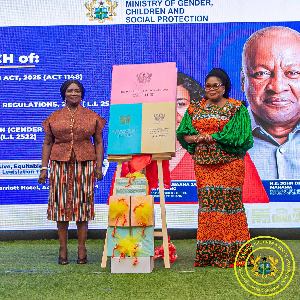 Veep Jane Naana Opoku Agyemang and Dr Agnes Naa Momo Lartey