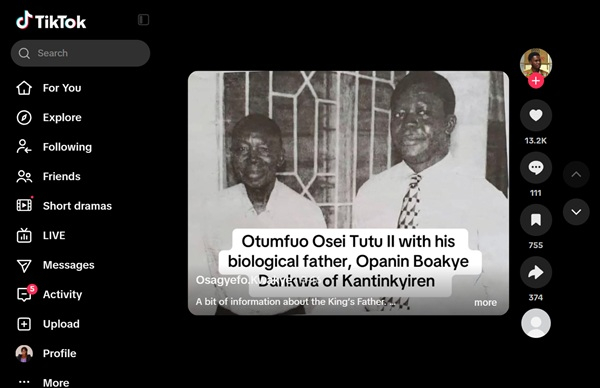
The Asante royal lineage is deeply rooted in history, tradition and carefully preserved family connections. Among the figures associated with this heritage is Nana Boakye Dankwa, the father of Asantehene Otumfuo Osei Tutu II and husband of the late Asantehemaa, Nana Afia Kobi Serwaa Ampem II.
Although public attention often centres on the Asantehene and his role as the occupant of the Golden Stool, the history of his paternal family offers an insight into the royal ancestry and relationships that have shaped the Asante Kingdom.
Here are five things to know about Boakye Dankwa and his place in Asante royal history.
He was an Ɔhenenana in the Asante royal lineage
Nana Boakye Dankwa was described as an Ɔhenenana, a traditional title referring to a paternal grandson of an Asantehene.
His name, Boakye, is believed to offer a possible clue to his royal ancestry. According to the historical account, the name may indicate a paternal connection to Asantehene Kwaku Dua Panin, who reportedly gave the name Boakye to several of his sons as an additional affiliated name.
However, this connection is presented as a possibility rather than a definitively established genealogical fact.
The title Ɔhenenana reflects the significance of royal descent in Asante tradition, where family lineage and relationships have historically played important roles in the organisation of the kingdom.
He was appointed Brahyiahene
Boakye Dankwa's royal connections extended beyond his paternal lineage. When his wife, Nana Afia Kobi Serwaa Ampem II, became Asantehemaa, the queen mother of the Asante Kingdom, he was appointed Brahyiahene, according to the account.
Nana Afia Kobi Serwaa Ampem II was the mother of Otumfuo Osei Tutu II, who ascended the Golden Stool in 1999.
The appointment linked Boakye Dankwa to the traditional responsibilities and institutions surrounding the Asantehemaa's position.
The Asantehemaa occupies an important place in the kingdom's traditional leadership structure, particularly in matters relating to royal succession, family lineage and customary affairs.
He was associated with Kantinkyiren near Trɛdɛ
The historical account identifies Kantinkyiren, near Adum Afrantwo and Trɛdɛ, as a settlement associated with several Ahenenana of the Asantehene. Ahenenana is the plural form of Ɔhenenana and refers to paternal grandsons of an Asantehene. The area was reportedly home to a number of these royal descendants, particularly those linked to the sons of Otumfoɔ Ɔsɛe Yaw Akoto.
One of the figures associated with Kantinkyiren was Kwabena Owusu, described in the account as a paternal grandson of Ɔsɛe Yaw Akoto.
This association provides a glimpse into the geographical and family networks through which Asante royal lineages were maintained across generations.
He married three women associated with important Asante royal families
The account also highlights marriages involving Kwabena Owusu, a figure it identifies with the Ɔhenenana lineage. These unions connected the family to several important Asante stools and royal households.
The three women and their family connections are outlined below:
Nana Yaa Asantewaa of the Ɛdweso Stool
Kwabena Owusu married Nana Yaa Asantewaa, identified as Ɛdwesohemaa. Their only daughter was Ama Seiwaa Brakatu, who later became Ɛdwesohemaa.
Nana Adwoa Kromoo of the Otumfoɔ Butuakwa Kyeame Stool
His second marriage was to Nana Adwoa Kromoo, whose family was associated with the Otumfoɔ Butuakwa Kyeame Stool. One of their daughters, Ama Seiwaa Ano, was the maternal grandmother of Kyeame Baafoɔ Akoto.
Nana Atiaa of the Botaase Royal Family of Mampɔn
Kwabena Owusu also married Nana Atiaa, who belonged to the Botaase Royal Family of Mampɔn. Their daughter, Ama Seiwaa Akoto, became Mampɔnhemaa.
These relationships illustrate how marriages connected royal families to traditional stools and helped sustain relationships among influential lineages within the Asante Kingdom.
The account identifies these marriages as part of the wider history of the family, although it does not establish that all three women were wives of Boakye Dankwa himself.
One of the broader themes emerging from the account is the importance of marriage among Asante royal families.
Historically, members of the Ahenema and Ahenenana lineages often married Adehyeɛ Maa, a term referring to royal women or princesses.
Such marriages helped maintain relationships between royal households and traditional stools, keeping important family connections within the wider royal network.
The practice, described in the account as keeping matters “all in the family”, reflects the historical importance attached to lineage, ancestry and kinship in Asante traditional society.
These family connections provide a broader context for understanding the royal heritage associated with Boakye Dankwa and the maternal and paternal lineages surrounding Otumfuo Osei Tutu II.
A legacy rooted in Asante tradition
The history associated with Boakye Dankwa offers a window into the family relationships and traditional institutions that underpin the Asante monarchy.
From his reported position as an Ɔhenenana to his appointment as Brahyiahene, his story is linked to a royal system in which ancestry, marriage and traditional titles have helped shape relationships across generations.
While further historical documentation would be needed to establish some of the genealogical connections conclusively, the account highlights the importance of preserving family histories as part of the wider heritage.
CLICK HERE TO VIEW POST
THE LOWDOWN: GES PRO Speaks on SHS Placement Crisis and Teachers’ Strike
General News of Monday, 12 October 2026
Source: www.ghanaweb.com
5 things to know about Boakye Dankwa, father of Otumfuo Osei Tutu II
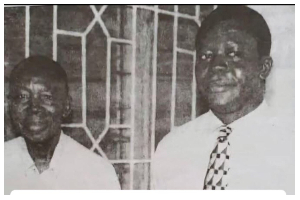 Otumfuo Osei Tutu II and his biological father, Nana Boakye Dankwa