Finance Minister Dr Cassiel Ato Forson has urged businesses to invest with confidence, saying the 2027 Budget will shift government’s focus from stabilizing the economy to transforming it.
Speaking at a meeting with the leadership of the Association of Ghana Industries (AGI) and captains of industry in Accra, Dr Forson said government would sustain the economic gains made over the past two years. He added that a new blueprint for economic transformation would be unveiled in the 2027 Budget.
“Feel free to invest because we will sustain the gains,” he told the industry leaders.
Dr Forson said the improvements in the macroeconomic environment would be protected and strengthened. The 2027 Budget, he said, “will move Ghana from stability to transformation.”
The Minister pointed to President John Dramani Mahama’s plan to invest US$10 billion in strategic sectors over the next four years. The programme is expected to prioritize domestic production, value addition, exports and job creation. Government has also signaled plans to reduce the cost of capital, a key constraint for manufacturers seeking to expand.
“The golden era for Ghana is beginning,” Dr Forson said.
The meeting formed part of the Finance Ministry’s stakeholder consultations ahead of the budget, which the Minister has indicated will be presented to Parliament in the first week of November. He said the consultations were aimed at identifying measures that would help businesses expand, export more and create jobs.
Dr Forson has said the 2027 Budget will outline major infrastructure projects and introduce fresh incentives to help businesses expand into new areas. At the Ghana-UK Investment Summit in June, he identified commercial agriculture, mining value addition, energy and transport infrastructure as priority sectors. He singled out gas-to-power and gas-to-fertilizer projects as central to the energy plan.
The Minister also called on the private sector to support domestic revenue mobilization. He argued that stronger domestic revenue would limit government borrowing and leave more room for banks to lend to businesses.
AGI President Kofi Nsiah-Poku welcomed the progress made in stabilizing the economy, but said the next priority should be industrial growth and job creation.
The promise of a growth-focused budget builds on a 2026 Budget that has so far met or beaten most of its key targets. Government recorded a growth rate of 6.2 percent in the first half of 2026, well above its full-year target of at least 4.8 percent. Non-oil growth for the period stood at 5.9 percent, against a target of 4.9 percent.
The fiscal numbers have been stronger still. Government recorded a budget deficit of GH¢3.5 billion in the first seven months of the year, against a target of GH¢31.0 billion. The primary balance posted a surplus of 1.4 percent of GDP, close to the full-year target of 1.5 percent. Interest costs came in at 1.3 percent of GDP by June, below the half-year target of 1.8 percent. The Finance Minister told Parliament in July that no new arrears had been accumulated in the first half of the year, and government did not seek a supplementary budget.
The 2026 Budget also delivered tax relief for businesses and consumers. It abolished the Electronic Transfer Levy, the betting tax and the Emissions Levy. VAT reforms that took effect in January cut the aggregate effective VAT charge from about 21.9 percent to 20 percent and raised the VAT registration threshold for businesses dealing in goods from GH¢200,000 to GH¢750,000.
The performance has not been without strain. Revenue fell marginally short of target, and the strong fiscal outturn was achieved largely by restraining spending. Foreign-financed capital expenditure was cut by GH¢3 billion following slower disbursement of bilateral loans. Public debt has also continued to rise, reaching GH¢733.9 billion, or 45.9 percent of GDP, in July, from 44.7 percent at the end of 2025.
Conditions for businesses have improved markedly. Inflation stood at 5.0 percent in August, down from 23.8 percent at the end of 2024. The average bank lending rate has fallen to 15.9 percent from 24.2 percent a year ago, and private-sector credit grew 35.5 percent in the year to August.
Business News of Wednesday, 30 September 2026
Source: economytimesnews.com
2027 Budget to bring major changes for businesses – Finance Minister
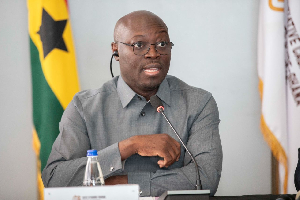 Dr Cassiel Ato Forson is the Minister of Finance