A Member of Parliament is often one of the most visible political figures in a constituency.
As such, constituents may turn to their Member of Parliament when a road is bad, a community needs a school, a health facility needs refurbishment, or a government project has stalled.
But how much power does an MP actually have?
While MPs have significant constitutional powers as members of Ghana’s legislative arm of government, they do not personally control every government project or public institution in their constituencies.
The 1992 Constitution gives Parliament legislative, representative, financial and oversight responsibilities.
Parliament itself describes its three core roles as making laws, representing the people and exercising oversight over the Executive.
So, what can an MP actually do?
1. An MP can help make the laws of Ghana
The most fundamental power of an MP comes from Parliament's legislative authority.
Article 93 of the 1992 Constitution vests the legislative power of Ghana in Parliament.
MPs therefore participate in the consideration and passage of Bills that can eventually become laws.
This means an MP has a direct role in determining the legal framework under which the country operates.
Whether the issue concerns taxation, education, public administration, health, security or another area of national policy, Parliament can debate and legislate on matters within its constitutional mandate.
2. An MP can question government officials and scrutinise the Executive
One of Parliament's major powers is oversight.
Parliamentary committees can investigate and inquire into the activities and administration of ministries and departments.
Under Article 103, committees can exercise significant investigative powers, including requiring witnesses to attend and compel the production of documents.
This gives MPs a mechanism to examine how government institutions are performing and how public policies and programmes are being implemented.
An MP can therefore use Parliament to demand explanations about government decisions and raise concerns about matters affecting citizens.
3. MPs have a say in how public money is approved
Parliament also has an important role in the country's finances.
The Constitution provides that taxation cannot be imposed except under the authority of an Act of Parliament. It also gives Parliament a role in certain tax waivers and variations.
Parliament also considers government expenditure through the budget process.
The Parliamentary Budget Committee, for example, examines the Medium-Term Expenditure Framework and Policy Targets, scrutinises the Appropriation Bill and considers other budget-related matters.
So, while an individual MP does not control the national purse, MPs collectively have constitutional powers over legislation, taxation and public expenditure.
4. An MP can use parliamentary committees to investigate problems
Much of Parliament's work happens through committees rather than on the floor of the House.
Every MP must belong to at least one standing committee.
These committees can investigate matters within their mandates and examine the activities and administration of ministries and departments.
For example, an MP serving on a committee responsible for a particular sector can scrutinise the ministry responsible for that sector, examine its programmes and raise questions about its performance.
This is one reason committee membership can be an important part of an MP's work even though it may receive less public attention than parliamentary debates.
5. MPs can influence government through oversight
An MP does not have to be a government minister to influence government policy.
Parliament's oversight role gives MPs a formal avenue to scrutinise decisions and implementation.
Questions can be directed at ministers, issues can be raised during parliamentary proceedings and committees can investigate matters within their remit.
Eight Terms and Counting: Meet Ghana’s longest-serving MP Collins Dauda
The power here is primarily one of scrutiny, accountability and legislative action and does not mean direct of the executive.
So, while an MP can demand an explanation from a sector minister, it does not mean that the MP can personally instruct the ministry to carry out every request from constituents.
6. MPs can represent constituency concerns
An MP is also a representative.
Parliament's role includes representing the people, meaning constituency concerns can be brought into national discussions and parliamentary proceedings.
This can involve raising concerns about a community, asking questions, engaging relevant government institutions or advocating for projects and services.
An MP can therefore be an important link between constituents and central government.
This is where the practical and constitutional roles can sometimes overlap.
An MP can use political influence and their position as a representative to advocate for development projects.
They can bring community concerns to the attention of ministers, government agencies and other authorities.
They can also use parliamentary oversight to ask questions about projects or programmes.
But advocacy is different from direct control.
A project may be located in an MP's constituency without being an MP's project.
Similarly, an MP may take credit for helping to facilitate a project without being the institution legally responsible for implementing it.
Collectively, MPs exercise Parliament's constitutional powers over legislation and government accountability.
JKB/VPO
Inside Ghana’s Abandoned Engineering Powerhouse: What Went Wrong?
General News of Wednesday, 30 September 2026
Source: www.ghanaweb.com
What power does an MP really have? Here’s what the law says
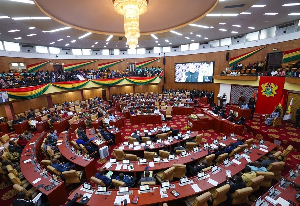 File photo of Ghana's Parliament