Government recorded a budget deficit of GH¢3.5 billion in the first seven months of 2026, much lower than its target of GH¢31.0 billion for the period by GH¢27.5 billion. Public debt, however, continued to rise, climbing by GH¢92.8 billion over the same period.
The overall fiscal deficit, measured on a commitment basis, was equivalent to 0.2 percent of gross domestic product (GDP), against a target of 1.9 percent of GDP, according to the Bank of Ghana (BoG). It means government used only about 11 percent of the deficit allowance it had set for January to July.
The primary balance, which excludes interest payments, recorded a surplus of 1.4 percent of GDP against a target surplus of 0.2 percent. That puts government ahead of pace on its full-year target of a 1.5 percent primary surplus, although spending typically rises in the final months of the year.
Governor of the BoG, Dr Johnson Pandit Asiama, presented the figures at the end of the 132nd meeting of the Monetary Policy Committee (MPC) in Accra. He attributed the outturn to improved revenue mobilization combined with tight control of spending.
Provisional data on government budget execution for the first seven months of 2026 “reflected improvement in revenue mobilization with marginal shortfalls below target, alongside constrained total spending,” the Governor said. He added that the deficit was financed largely from domestic sources.
The performance was driven more by spending restraint than by revenue. Although revenue fell marginally short of target, it improved on last year. Total revenue and grants reached 9.1 percent of GDP by July 2026, compared with 8.4 percent in the same period of 2025. Tax revenue rose to 7.5 percent of GDP from 7.0 percent.
Total expenditure, by contrast, was held at 9.2 percent of GDP, slightly below the 9.3 percent recorded a year earlier. Within that envelope, capital expenditure doubled to 1.5 percent of GDP from 0.7 percent, suggesting that the squeeze has fallen more on recurrent spending than on investment.
Government says the spending restraint has not come at the cost of new debts to suppliers. The Finance Minister told Parliament that no new arrears were accumulated in the first half of 2026.
The approach reflects a deliberate shift in fiscal strategy. Presenting the 2026 Mid-Year Budget Review to Parliament in July, Finance Minister Dr Cassiel Ato Forson said government had recalibrated its programme with the International Monetary Fund (IMF) from revenue-led to expenditure-led consolidation. Government has cut the number of ministers from a peak of 123 to 60 and the number of ministries from 30 to 23. It has also reduced spending on foreign travel, workshops, conferences and official vehicles.
Lower borrowing costs have also helped. Interest payments stood at 1.3 percent of GDP at the end of June, against a half-year target of 1.8 percent, as interest rates declined. The 91-day Treasury bill rate fell to 5.38 percent in August 2026 from 10.26 percent a year earlier.
Despite the strong fiscal outturn, public debt has continued to grow. Total public debt rose to GH¢733.9 billion at the end of July 2026 from GH¢641.1 billion at the end of December 2025. As a share of GDP, debt climbed to 45.9 percent from 44.7 percent over the same period.
The rise is concentrated in domestic debt, which increased by GH¢62.9 billion to GH¢396.7 billion, or 24.8 percent of GDP, up from GH¢333.8 billion. That increase is far larger than the deficit recorded over the period.
External debt rose by GH¢29.8 billion in cedi terms, to GH¢337.2 billion. In dollar terms, however, it declined, from US$29.4 billion at the end of 2025 to US$28.8 billion in July. The increase in the cedi value of external debt therefore reflects the depreciation of the local currency rather than an increase in external borrowing. The cedi has depreciated by 9.5 percent against the US dollar so far this year.
The Bank of Ghana has attributed the rise largely to domestic borrowing aimed at strengthening fiscal buffers and meeting future debt-service obligations. According to the central bank, the growth in domestic debt reflected strong investor appetite for 364-day Treasury bills, tap-ins of existing medium- and long-term bonds, the effect of the cedi’s depreciation on dollar-denominated domestic bonds, and the recapitalization of the Bank of Ghana, for which government issued a GH¢5 billion bond in March 2026.Part of the borrowing is being channeled into a Sinking Fund to meet upcoming debt maturities. The fund is financed from 7 percent of non-oil tax revenue and proceeds from domestic bond issuances. It held GH¢15.6 billion as of July 22, 2026, against a year-end target of GH¢30 billion.
The fund is designed to cover large maturities of bonds issued under the Domestic Debt Exchange Programme (DDEP). GH¢58 billion of DDEP bonds mature in 2027 and GH¢53 billion in 2028.
Government is also servicing its restructured external debt. It had paid a total of US$2.1 billion in principal and interest to Eurobond holders since January 2025, according to the Mid-Year Review. Further Eurobond payments are expected in the coming months.
When asked whether those payments would drain the country’s reserves, Dr Asiama said they had been anticipated and built into the central bank’s foreign exchange cash flow plans. “Those payments are planned, they are anticipated, they are projected, and we will be able to meet those without too much pressure,” he said.
He added that the Ministry of Finance has been creating buffers to meet the large payments.
The fiscal performance marks a sharp turnaround from 2024. Public debt fell from 61.8 percent of GDP at the end of 2024 to 44.7 percent at the end of 2025, while the primary balance moved from a deficit of 2.9 percent of GDP in 2024 to a surplus of 2.5 percent in 2025.
Business News of Wednesday, 30 September 2026
Source: economytimesnews.com
Government deficit drops to GH¢3.5 billion, debt increases to GH¢733.9 billion
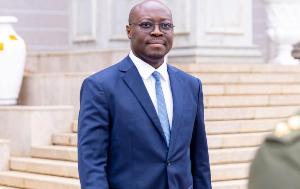 Dr Cassiel Ato Forson is the Minister of Finance