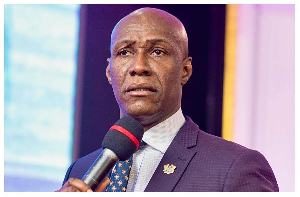
The Founder of UT Group, Prince Kofi Amoabeng, has urged Ghanaian entrepreneurs to learn how to navigate the country’s “unspoken” business rules by building strong systems, staying disciplined and resisting the pressure to become successful overnight.
According to him, young businesses can initially operate “under the radar” and grow steadily if they establish the right culture, policies and structures before attracting wider attention.
Ghana has enough grains to repay ECOWAS – Eric Opoku
Speaking on The Peswa Podcast sighted by GhanaWeb Business on Sunday September 27, 2026, Prince Kofi Amoabeng said his experience in building UT Financial Services showed him that entrepreneurs could grow despite the challenges within Ghana’s business environment.
“It's a tough question, but I will encourage the young people to start. But when you start the business you are really under the radar. People don't know what you are doing and you can grow,” he said.
He explained that the key is to put proper systems in place from the beginning rather than relying solely on personal relationships or informal ways of doing business.
“If you have the structures and the culture is right and things like that, and you are principled about it, put policies in place, you can grow,” Prince Amoabeng said.
He recalled that when he started Unique Trust, the company was relatively unknown and did not initially attract the attention of major institutions.
However, as the business grew and its financial activities became more visible, regulators and other institutions began to take notice.
“When we started Unique Trust, nobody knew about us. Bank of Ghana wasn't even coming to audit us initially. It was when they saw our returns that we're submitting and our bank statements and the money flowing through it that even the core organisational institutions like Bank of Ghana, the banks started looking at us,” he said.
According to him, one of the biggest mistakes young entrepreneurs make is trying to display success too early.
He said business owners should reinvest in their companies instead of spending money trying to impress their peers.
“The problem I find with most young people is they want to be successful immediately,” he said.
“Sometimes when they see small money coming, they must buy a car and let people know that now is their turn. They should go to nightclubs and show off and order food,” he added.
Prince Amoabeng said such behaviour is often driven by peer pressure and can distract entrepreneurs from the long-term work required to build sustainable businesses.
“It's about peer pressure and trying to prove yourself to your peers,” he said, adding that entrepreneurs should instead concentrate on building businesses that can withstand pressure and grow over time.
He also cautioned young business owners against running their companies as though they were personal kingdoms, where the founder cannot be questioned or held accountable.
“A lot of young people start the business and they bring the traditional form of governance. It's like they are the chief and the owner of the business. You can't talk to me anyhow. You can't challenge me and I'm not accountable to anybody,” he said.
According to him, businesses become stronger when their owners establish clear policies and ensure that employees and managers are accountable for their actions.
“If you take any person, you account for it and you are transparent, everybody sees it and the policy is there,” he said.
Prince Amoabeng further argued that entrepreneurs need to understand the influence of relationships and informal networks in Ghana’s business environment, even while maintaining their principles.
He admitted that his own refusal to engage in politics, chieftaincy networks and other forms of influence sometimes made his businesses more vulnerable.
“One thing I didn't do well is I didn't play politics at all and I didn't also indulge in chieftaincy,” he said.
He said powerful individuals can sometimes influence business and government decisions, which can affect who gets opportunities.
“There are too many people who are influencers… influencing serious government decisions, and they are so powerful that they will let contracts and deals go to the wrong people and not those who have the merit and the resources and the capacity to actually execute it,” he said.
Despite these challenges, Prince Amoabeng urged young entrepreneurs not to be discouraged but to focus on building credible businesses from the start.
“To the young people don't be afraid. Start. Start on the right note,” he advised.
ANAS/EB
"I will tell you everything” - Prince Kofi Amoabeng
General News of Sunday, 27 September 2026
Source: www.ghanaweb.com
Captain (Rtd) Prince Kofi Amoabeng speaks on Ghana's 'unspoken' business rules
 Prince Kofi Amoabeng is the Founder of UT Group in Ghana