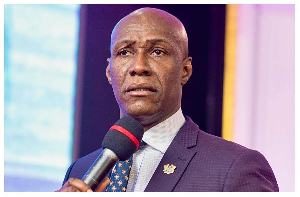
Bank of Ghana Governor Dr Johnson Pandit Asiama has dismissed concerns that recent irregularities in GoldBod’s export shipments could derail Ghana’s reserve accumulation strategy, insisting that the country’s external buffers remain on track under the Ghana Accelerated Reserve Accumulation Programme (GARAP).
Responding to questions on the impact of GoldBod’s exports on reserve targets and investor confidence, the Governor said Ghana remains firmly on course to achieve the medium-term objectives of GARAP despite recent global economic headwinds.
According to him, GARAP was designed as a medium-term strategy to strengthen the country’s international reserves beyond current levels, and it is still too early in the programme’s implementation cycle to draw conclusions about its effectiveness.
“Date-to-date, we are still at about 4.5 months of import cover, and we consider that to be adequate,” he said, noting that Ghana’s reserves remain significantly above the conventional benchmark of three months of import cover.
Dr Asiama stressed that reserve accumulation under GARAP is not dependent solely on gold exports. The central bank, he explained, is pursuing a diversified strategy that incorporates traditional and non-traditional export earnings to support external sector resilience.
Addressing concerns over reports that GoldBod had paused exports, the Governor clarified that export activities had not been suspended.
“It did not pause per se. It was just that shipments had become less regular compared to the last two quarters as of August,” he noted.
He revealed that export shipments have since rebounded strongly, with GoldBod making significant exports during the past week.
“In fact, only last week, GoldBod exported quite a significant amount of gold outside the country, and this is supporting the reserves build-up,” he said.
The Governor indicated that fresh data received by the Monetary Policy Committee showed a markedly different picture from what was available at the end of August.
“The story has changed between yesterday morning and this morning, based on the new data that just came in,” he stated.
While assuring markets that export volumes have resumed, Dr Asiama identified international gold price movements—not shipment volumes—as the principal risk to Ghana’s reserve accumulation efforts.
“What poses a risk is the international gold prices out there, and that one is not within our control,” he explained.
He observed that global monetary policy developments, particularly interest rate decisions in the United States, continue to influence gold prices and, by extension, Ghana’s export earnings.
“When the US increases its policy rate, gold prices tend to be depressed. These are external factors that we do not control,” he said.
Nevertheless, he expressed confidence that sustained export shipments and favourable gold market conditions would continue to support reserve growth.
“If the gold prices are comfortable, we are sure that the shipments will continue and thereby support our reserve accumulation going forward,” he added.
On foreign exchange market interventions, Dr Asiama rejected suggestions that Bank of Ghana’s actions are discretionary.
He explained that interventions are guided by a rules-based framework introduced under the central bank’s foreign exchange management strategy.
“It is not for me to just get up and say intervene. It is a clear rules-based system that we use to determine when we need to intervene,” he said.
The Governor further disclosed that the central bank is working with GoldBod on a revised framework that would enable the state gold trader to play a greater intermediation role in the foreign exchange market.
“We are in touch with GoldBod, trying to perfect that new framework. When we are ready, when it is done, we will communicate these to the markets,” he noted.
Despite these reforms, he said the central bank’s commitment to reserve accumulation remains unchanged.
“We will continue to play our intervention role, but our prime objective is to build adequate reserves at all times because that is what supports our resilience as a country,” Dr Asiama said.
The Governor’s remarks are likely to reassure investors who have been closely monitoring the role of GoldBod in supporting foreign exchange inflows and strengthening Ghana’s reserve position amid evolving global economic conditions.
With export shipments resuming and reserve cover remaining above accepted thresholds, the central bank appears confident that GARAP remains on track.
Business News of Sunday, 27 September 2026
Source: businesspostonline.com